The Powerplus
The Powerplus
Recalling The Time When America Produced The Very Best Motorcycles In The World.
Richard C. Renstrom
MOTORCYCLE aficionados are inclined to call the great European bikes "classics" and all older American motorcycles "antiques."
This really isn’t very logical if one uses the definition that an outstanding design which is years ahead of its time is considered to be classical regardless of its age or country of origin.
Consider the case of the 1916 to 1920 Indian “Powerplus”—a 61-cu. in. V-Twin that was the pride of the Hendee Manufacturing Company in Springfield, Mass. This model had a three-speed countershaft gearbox, mechanical lubrication, an internal expanding brake, total enclosure of the valve gear, magneto ignition, all chain drive, a kickstarter, and a swinging arm rear suspension.
Today these would be considered quite ordinary specifications, but in 1916 they bordered upon the visionary. The typical British bike in those days had either a single-speed belt drive or possibly a two-speed gearbox, no rear suspension, exposed valves that leaked oil all over the engine, and a hand operated pump for lubrication.
The Indian Powerplus can rightfully be called a genuine classic—it’s one of the few. It is not surprising that a true classic should emerge from those early years of motorcycle production in America, since the Yankee bikes of that era were decidedly superior to their European brothers.
By the middle 1920s the Europeans had definitely assumed the leadership, since a booming market over there fostered an intensive effort to build better bikes, while in America the trend was to the automobile and away from good motorcycles.
Proof of this American superiority was the 1911 Isle of Man TT—the first event over the 37-mile “Mountain Circuit.” The Indian Twins with chain drive and a two-speed gearbox took the first three places that year, which proved the validity of the chain drive and gearbox theory over the belt drive approach favored by the British. Indian was also victorious over the British bikes in a special match race at Brooklands later in the year, and for the following 12 years the American Indians and Harley -Davidsons were common sights in races all over Europe.
Indian rider Eugene Walker was the first to officially break the 100 mph barrier in the FIM record book when he clocked 103.95 mph at Daytona Beach in 1920. Walker followed this up with a 114 mph clocking by stopwatch, and then Johnny Seymour did a cool 132 mph on his Indian in 1926—speeds beyond anything attained in Europe.
During these early years Indian was one of the largest manufacturers of motorcycles in the world—producing no less than 35,000 bikes in 1913 alone. Being of simple and rugged design, some of these early warriors have endured to this day. Many have been lovingly restored to concours condition, and they are usually the point of pride in anybody’s collection of ancient American iron.
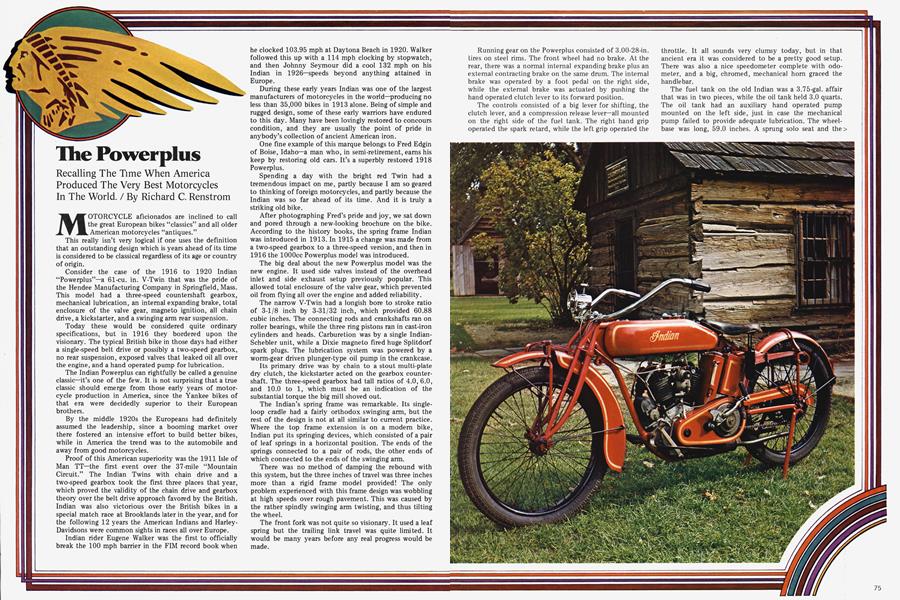
One fine example of this marque belongs to Fred Edgin of Boise, Idaho—a man who, in semi-retirement, earns his keep by restoring old cars. It’s a superbly restored 1918 Powerplus.
Spending a day with the bright red Twin had a tremendous impact on me, partly because I am so geared to thinking of foreign motorcycles, and partly because the Indian was so far ahead of its time. And it is truly a striking old bike.
After photographing Fred’s pride and joy, we sat down and pored through a new-looking brochure on the bike. According to the history books, the spring frame Indian was introduced in 1913. In 1915 a change was made from a two-speed gearbox to a three-speed version, and then in 1916 the lOOOcc Powerplus model was introduced.
The big deal about the new Powerplus model was the new engine. It used side valves instead of the overhead inlet and side exhaust setup previously popular. This allowed total enclosure of the valve gear, which prevented oil from flying all over the engine and added reliability.
The narrow V-Twin had a longish bore to stroke ratio of 3-1/8 inch by 3-31/32 inch, which provided 60.88 cubic inches. The connecting rods and crankshafts ran on roller bearings, while the three ring pistons ran in cast-iron cylinders and heads. Carburetion was by a single IndianSchebler unit, while a Dixie magneto fired huge Splitdorf spark plugs. The lubrication system was powered by a worm-gear driven plunger-type oil pump in the crankcase.
Its primary drive was by chain to a stout multi-plate dry clutch, the kickstarter acted on the gearbox countershaft. The three-speed gearbox had tall ratios of 4.0, 6.0, and 10.0 to 1, which must be an indication of the substantial torque the big mill shoved out.
The Indian’s spring frame was remarkable. Its singleloop cradle had a fairly orthodox swinging arm, but the rest of the design is not at all similar to current practice. Where the top frame extension is on a modern bike, Indian put its springing devices, which consisted of a pair of leaf springs in a horizontal position. The ends of the springs connected to a pair of rods, the other ends of which connected to the ends of the swinging arm.
There was no method of damping the rebound with this system, but the three inches of travel was three inches more than a rigid frame model provided! The only problem experienced with this frame design was wobbling at high speeds over rough pavement. This was caused by the rather spindly swinging arm twisting, and thus tilting the wheel.
The front fork was not quite so visionary. It used a leaf spring but the trailing link travel was quite limited. It would be many years before any real progress would be made.
Running gear on the Powerplus consisted of 3.00-28-in. tires on steel rims. The front wheel had no brake. At the rear, there was a normal internal expanding brake plus an external contracting brake on the same drum. The internal brake was operated by a foot pedal on the right side, while the external brake was actuated by pushing the hand operated clutch lever to its forward position.
The controls consisted of a big lever for shifting, the clutch lever, and a compression release lever—all mounted on the right side of the fuel tank. The right hand grip operated the spark retard, while the left grip operated the throttle. It all sounds very clumsy today, but in that ancient era it was considered to be a pretty good setup. There was also a nice speedometer complete with odometer, and a big, chromed, mechanical horn graced the handlebar.
The fuel tank on the old Indian was a 3.75-gal. affair that was in two pieces, while the oil tank held 3.0 quarts. The oil tank had an auxiliary hand operated pump mounted on the left side, just in case the mechanical pump failed to provide adequate lubrication. The wheelbase was long, 59.0 inches. A sprung solo seat and the> spring frame yielded the softest ride going in those early days.
The 1918 catalog listed two Powerplus models—one with a generator, battery, and lights and the other without the electrics. No lights weren’t required then unless you rode after dark, which is not surprising since the poor roads discouraged nighttime travel.
The power output of the side valve engine was listed as 15 to 18 horsepower, with no engine speed listed. Side-valve engines of that era were normally turning over at 3500 to 4000 rpm, which would have provided a 70 to 80 mph performance on the tall 4:1 top gear. This would have been really flying for those days. Especially so, over the poor roads in use then.
According to the Indian brochure, the reason for going to a side-valve engine was to obtain more power, reliability, and a clean running engine. In regards to the long stroke, the brochure had this to say: “This long stroke gives the Powerplus its phenomenal power and a wonderful impetus to the pull, reducing gear shifting to a minimum and carrying on high gear excessive loads that a motor of short stroke could not negotiate without constant gear changing.” What a contrast to the contemporary approach of short strokes, lots of revs, and many gears to keep on the power curve!
One performance option for the rider was the three “cut-out” holes in the exhaust system, which were operated by a foot lever. When extra power was needed on a long hill, the rider could thus by-pass the muffler and obtain several extra “horses.” All rather quaint, but not very legal today!
The color scheme of the 1918 Powerplus was striking, with a “fire engine” red used for nearly all chassis parts. Fred Edgin has authentically striped his model in delicate gold on the fuel tank, oil tank, and fenders. Fred has also chromed a few parts as well as glass bead-blasted all the alloy cases, which combines with a deep black on the cylinders and heads.
The most remarkable thing about the Powerplus model was the use of a swinging arm for a rear suspension. Other than being rather frail looking, the setup is identical to what we know today in its design and method of mounting. In fact, if a pair of modern shock units were substituted for the connecting rods and the leaf springs were replaced by a solid frame section, we would have a totally modern swinging arm suspension. Spring-oil shock units were not available in 1918, though, so the Indian engineers were forced to try another approach.
The swinging arm frame was not re-introduced until 1936, when the British Velocette concern used the system on its overhead camshaft works racers. The 350cc KTT
replica racer then appeared in 1939 with a swinging arm, which was the first “for sale” model available to the public. After the war, AJS, Matchless, and Royal Enfield introduced the design in 1949 on their full range of bikes, with the others falling in line during the middle 1950s. The old Velocette Singles, incidentally, used an air-oil shock, since spring-oil shocks were not available for bikes until 1949. That’s how far ahead Indian was.
But the Indian springer was a doomed model. In 1919 Charles B. Franklin joined the company, and in the following dozen years Indian became known for its fast and dependable side-valve models. Unfortunately, the spring frame got lost in the shuffle, and after 1921 the Indians reverted to a rigid frame until 1940, when the big 74 inch “Chief” appeared with the old style plunger rear suspension.
After World War II, Indian staggered on—lacking the brilliance of its early engineering. The last true Indians were produced in 1953, and then the company began importing British bikes. Even this eventually failed due to bad management, so that the once great company became just a colorful memory—kept alive by men such as Sammÿ Pierce and other dedicated aficionados around the world.
Today, Fred Edgin is a proud man—proud because he has restored a great piece of history to concours condition. When you stand before Fred’s red Indian, you feel history. Memories of the early Isle of Man races, Brooklands, and tracks all over America. People in funny hats, scarves, and smock coats. Little, cramped streets, bumpy, dirt highways, and lots of room to breathe. jo]