Service
SERVICE
PAUL DEAN
Lost your bearings?
Q After replacing the front wheel bearings on my 2001 Kawasaki 500 Ninja, I can’t get the wheel to turn. It spins easily when the axle nut is loose, but as soon as I tighten it, the wheel refuses to turn. I’ve had the wheel off and on three times, always following the directions in the shop manual, and I haven’t left out any spacers or installed anything improperly. I’m at wit’s end and desperately need some advice. Got any? Cliff Gardner
Sioux City, Iowa
If you have indeed installed all of the spacers and the speedometer drive correctly, I suspect that one or both of the wheel bearings is not fully seated in its mounting boss. This sometimes occurs because of the manner in which the bearings were both removed and installed.
I don’t know what method you used, but most home mechanics (and many who work in motorcycle shops) drive old bearings out from behind with a hammer and a drift, then install new ones in a similar manner. The problems with this technique are: 1) The bearings are an interference fit in the boss, so you are using potentially damaging brute force to remove and install them; and 2) it is virtually impossible to hit the bearing squarely with every impact. As a result, the bearing tends to “walk” in the mounting boss, rocking slightly sideto-side with each impact as it moves; and because the bearing is such a tight fit in the boss, that walking motion can cause the outside edge of the outer race to shave little slivers of aluminum from the boss’s walls as it moves. Sometimes, in fact, even pushing bearings in and out with a hydraulic press can have the same result.
When this happens during installation, the slivers can collect in the bottom of the boss and prevent the bearing from fully seating. Consequently, the two bearings are slightly farther apart than intended, which also means that the long spacer tube between the bearings is now shorter than the distance between the bearings’ inner races. So, when you tighten the axle, the inner races are pinched together, which moves them out of alignment with the outer races, binding up the bearing. The wheel now refuses to turn.
Your first step in solving this problem is to remove the new bearings and throw them away; the same pinching forces that kept the wheel from turning also probably damaged the bearings enough that they would fail prematurely. Next, carefully inspect the mounting bosses and thoroughly clean them of any metal shavings or other residue that you might have missed the first time. If you can detect any small gouges or burrs on the sides of the bosses, use fine sandpaper to clean them up.
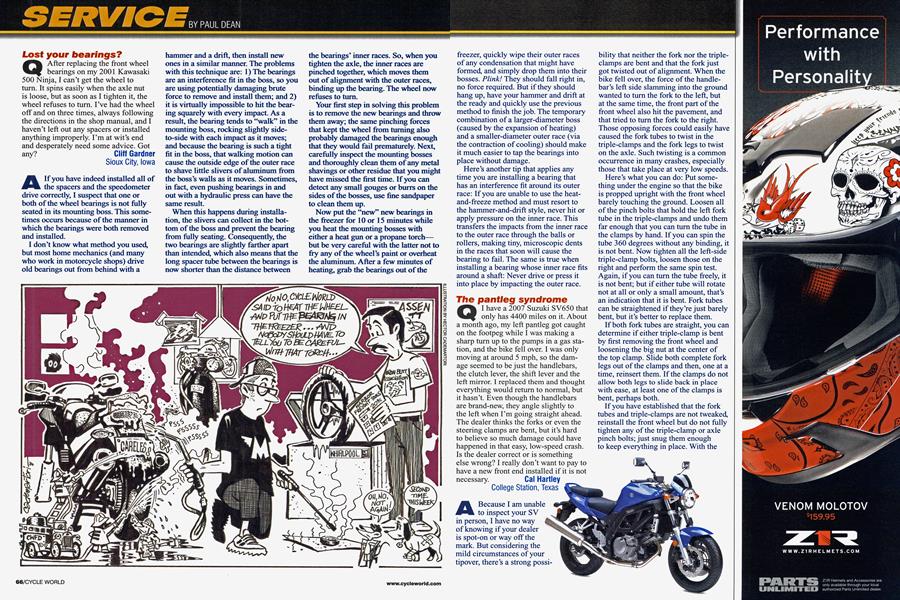
Now put the “new” new bearings in the freezer for 10 or 15 minutes while you heat the mounting bosses with either a heat gun or a propane torch— but be very careful with the latter not to fry any of the wheel’s paint or overheat the aluminum. After a few minutes of heating, grab the bearings out of the freezer, quickly wipe their outer races of any condensation that might have formed, and simply drop them into their bosses. Plink! They should fall right in, no force required. But if they should hang up, have your hammer and drift at the ready and quickly use the previous method to finish the job. The temporary combination of a larger-diameter boss (caused by the expansion of heating) and a smaller-diameter outer race (via the contraction of cooling) should make it much easier to tap the bearings into place without damage.
Here’s another tip that applies any time you are installing a bearing that has an interference fit around its outer race: If you are unable to use the heatand-freeze method and must resort to the hammer-and-drift style, never hit or apply pressure on the inner race. This transfers the impacts from the inner race to the outer race through the balls or rollers, making tiny, microscopic dents in the races that soon will cause the bearing to fail. The same is true when installing a bearing whose inner race fits around a shaft: Never drive or press it into place by impacting the outer race.
The pantleg syndrome
QI have a 2007 Suzuki SV650 that only has 4400 miles on it. About a month ago, my left pantleg got caught on the footpeg while I was making a sharp turn up to the pumps in a gas station, and the bike fell over. I was only moving at around 5 mph, so the damage seemed to be just the handlebars, the clutch lever, the shift lever and the left mirror. I replaced them and thought everything would return to normal, but it hasn’t. Even though the handlebars are brand-new, they angle slightly to the left when I’m going straight ahead. The dealer thinks the forks or even the steering clamps are bent, but it’s hard to believe so much damage could have happened in that easy, low-speed crash. Is the dealer correct or is something else wrong? I really don’t want to pay to have a new front end installed if it is not necessary. Cal Hartley
College Station, Texas
A Because I am unable to inspect your SV in person, I have no way of knowing if your dealer is spot-on or way off the mark. But considering the mild circumstances of your tipover, there’s a strong possibility that neither the fork nor the tripleclamps are bent and that the fork just got twisted out of alignment. When the bike fell over, the force of the handlebar’s left side slamming into the ground wanted to turn the fork to the left, but at the same time, the front part of the front wheel also hit the pavement, and that tried to turn the fork to the right. Those opposing forces could easily have caused the fork tubes to twist in the triple-clamps and the fork legs to twist on the axle. Such twisting is a common occurrence in many crashes, especially those that take place at very low speeds.
Here’s what you can do: Put something under the engine so that the bike is propped upright with the front wheel barely touching the ground. Loosen all of the pinch bolts that hold the left fork tube in the triple-clamps and undo them far enough that you can turn the tube in the clamps by hand. If you can spin the tube 360 degrees without any binding, it is not bent. Now tighten all the left-side triple-clamp bolts, loosen those on the right and perform the same spin test. Again, if you can turn the tube freely, it is not bent; but if either tube will rotate not at all or only a small amount, that’s an indication that it is bent. Fork tubes can be straightened if they’re just barely bent, but it’s better to replace them.
If both fork tubes are straight, you can determine if either triple-clamp is bent by first removing the front wheel and loosening the big nut at the center of the top clamp. Slide both complete fork legs out of the clamps and then, one at a time, reinsert them. If the clamps do not allow both legs to slide back in place with ease, at least one of the clamps is bent, perhaps both.
If you have established that the fork tubes and triple-clamps are not tweaked, reinstall the front wheel but do not fully tighten any of the triple-clamp or axle pinch bolts; just snug them enough to keep everything in place. With the help of a friend, kneel down and sight along the front wheel to align it perfectly with the rear while your compadre holds the handlebars. Once that frontto-rear alignment is correct, tighten the axle and all of the pinch bolts. If your diagnoses have been accurate, the handlebars should now be perpendicular to the front wheel, just like it should be.
Lean and not so mean
Q I have a 2005 Honda VFR800A (Canadian model) with 59,000 kilometers showing. It always has been completely serviced, including VTEC valve maintenance. I love this bike, but it has a peculiar trait: When it’s cold, the throttle response is bang-on, requiring only a little bit of throttle and a corresponding little bit of engine response to pull away, all very civilized. But when it’s warm, the same little bit of throttle does not result in the same engine response; instead of rolling off the line, it stalls! Getting a clean getaway requires more throttle twist, more revs and a much lesselegant launch. I even had a seasoned rider friend try it, and yup, it stalled.
He said I should live with it, but I can’t. In June of last year, while I was pulling away from a stop sign and making a 90-degree right turn, the bike stalled and went down so fast that I couldn’t do a thing to stop it and consequently broke my foot. Six weeks with NO riding. Please help! Rod Collins Moncton, New Brunswick, Canada
A Your VFR—like any fuel-injected bike—automatically is fed a rich mixture when cold so it can run and respond decently. As its engine warms, the mixture is gradually leaned out until it achieves the ratio needed for the bike to meet the emissions standards required in 2005. If, however, the warm-engine mixture becomes too lean, it can cause the kind of stalling and poor throttle response you describe. The method by which emissions are officially certified results in the greatest degree of leanness at smaller throttle openings, so the effects are most apparent down at or just above idle speeds. The engine doesn’t stall when cold partly because the idle speed is higher and partly because a small percentage of leanness in a very rich mixture has far less effect than that same degree of leanness in a mixture that already is marginally lean.
From this distance, it’s hard for me to pinpoint exactly what is causing your VFR’s lean mixture. It could be something simple like a vacuum leak or slightly dirty injector nozzles (their multiple orifices are very, very tiny) to a more involved problem such as a misadjusted or faulty throttle-position sensor or an issue with any of the bike’s seven other EFI sensors.
Unfortunately, the problem would be very difficult for you to track down on your own. The VFR800 has such a complex injection system that the EFI segment in the factory shop manual is 92 pages long! It describes an extensive series of tests and adjustments that require several special tools and possibly even the partial disassembly of the fuel system. If you have not yet addressed this problem with a Honda dealer, it is time to do so.
Got that synching feeling
Q HOW important is carburetor
balance? The performance of my 2006 Yamaha YZF600R has faded over the past couple of months, and I want to bring it back up to snuff. It only has 9000 miles on it and is in really good shape, and it bugs me that it has started to run crappy. It’s okay at low revs when I’m just running around town, but it surges when I’m cruising on the highway and misfires a little when I open it up all the way. A riding friend suggested that the carbs needed to be balanced, and that’s something I’ve never done on this bike, which I bought new in 2007. What are your thoughts? Kevin Burgess
Fort Wayne, Indiana
A I’m sure your friend means well, but he’s wrong; carb imbalance would not cause the symptoms your Yamaha is exhibiting. The reason that carburetors need to be balanced (“synchronized” is the term most often used) is to ensure that all the carb settings are the same when the engine is idling and that all the butterfly valves (or the slides on slide/needle carbs) will open at precisely the same time when the throttle is twisted. Out-of-synch carbs therefore can cause an erratic idle, as well as a stumble when the throttle is first opened at idle; but once the throttle has been opened beyond about the one-quarter point, carb balance is not significant. The butterflies still will not be in perfect synchronization, but the percentage of difference that imperfection makes in airflow through the carbs is much smaller when the throttle is opened than it is when closed.
Instead, your YZF-R has another problem. It could be the result of partially clogged fuel jets in the carbs or an intermittent sparkplug misfire or a weak ignition coil or even a bad plug
wire. You or your mechanic will need to conduct a systematic troubleshooting procedure to locate the source of the surging and misfire, and to correct the problem. E2
Got a mechanical or technical problem with your beloved ride? Can’t seem to find workable solutions in your area? Or are you eager to learn about a certain aspect of motorcycle design and technology? Maybe we can help.
If you think we can, either: 1) Mail a written inquiry, along with your full name, address and phone number, to Cycle World Service, 1499 Monrovia Ave., Newport Beach, CA 92663; 2) fax it to Paul Dean at 949/6310651; 3) e-mail it to CW1Dean@aol.conr, or 4) log onto www.cycleworld.com, click on the “Contact Us” button, select “CW Service” and enter your question. Don’t write a 10page essay, but if you’re looking for help in solving a problem, do include enough information to permit a reasonable diagnosis. And please understand that due to the enormous volume of inquiries we receive, we cannot guarantee a reply to every question.