Big Bear Bike
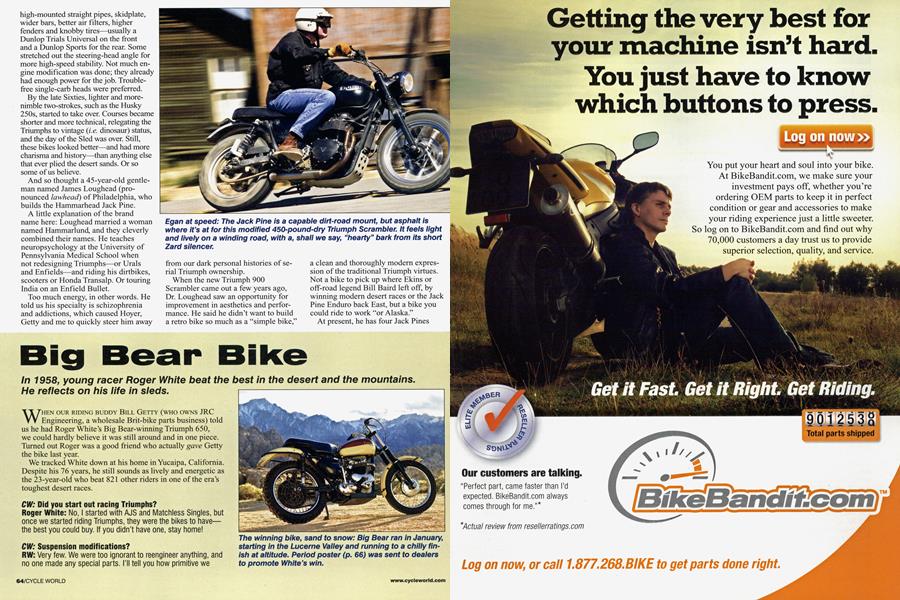
Big Bear Bike
In 1958, young racer Roger White beat the best in the desert and the mountains. He reflects on his life in sleds.
WHEN OUR RIDING BUDDY BILL GETTY (WHO OWNS JRC Engineering, a wholesale Brit-bike parts business) told us he had Roger White’s Big Bear-winning Triumph 650, we could hardly believe it was still around and in one piece. Turned out Roger was a good friend who actually gave Getty the bike last year.
We tracked White down at his home in Yucaipa, California. Despite his 76 years, he still sounds as lively and energetic as the 23-year-old who beat 821 other riders in one of the era’s toughest desert races.
CW: Did you start out racing Triumphs?
Roger White: No, I started with AJS and Matchless Singles, but once we started riding Triumphs, they were the bikes to have— the best you could buy. If you didn’t have one, stay home!
CW: Suspension modifications?
RW: Very few. We were too ignorant to reengineer anything, and no one made any special parts. I’ll tell you how primitive we were: We took old sparkplugs, broke off the porcelain and screwed them into the tops of the fork springs to make 1-inch spacers so our springs wouldn’t top out and bang around, but they still bottomed out.
CW: What about engine modifications?
RW: No, not really. The Triumph 650 engine had more power and torque than we could use— what we needed was suspension. You could easily override those bikes in most conditions, which is almost impossible with modern dirtbikes.
CW: Frame geometry changes?
RW: No, we didn’t worry about anything that subtle. We rode what we had, and my feeling was, “If you want to go faster, twist the throttle and ride that darned thing!”
CW: Were you connected to a Triumph dealership?
RW: No, I was framing houses in the construction trade six days a week and racing for fun on the weekends. Bud Ekins was Triumph’s guy. He owned a Triumph dealership, had all the best stuff and he was the man to beat. A great rider and a nice guy. I told him once he had to put something different on the back of his bike so I’d have something new to look at. He said if I ever beat him, he’d give me a set of his pipes—and he did. Bud made the pipes that are on Getty’s bike now.
CW: What happened after you won Big Bear?
RW: It was a busy year for me. I won Big Bear, got married, won the Open Class in the last Catalina Grand Prix—on a BSA Spitfire—and then I got drafted into the Army. I wanted to run the ’59 Big Bear, so I went AW0L from Ft. Lewis, Washington, drove down to Southern California and finished third in the race. When I got back to Ft. Lewis, I turned myself in and told my company commander I’d left without leave because I had an illness in the family. He grinned and said,
heard you finished third.”
CW: What was it like racing Big Bear?
RW: We did a big loop through the desert, refueled and then did another loop and headed into the mountains up the aptly named Rattlesnake Canyon—it was a man-killer—and into the snow for the last third of the race. It was 160-some miles, and most people didn’t finish. But I was 23 years old and bulletproof. I was kind of an iron man in those days and could have turned right around and done it again; I wasn’t even tired. —Peter Egan