The Places Motorcycles Take Us
The Places Motorcycles Take Us
PETER EGAN
LEANINGS
I FIGURED AS LONG AS WE HAD A BLINDing blizzard this morning, it would be a good day to see if the new Finnishmade Nokian snow tires worked on my car. I'd bought them on the theory that no one knows more about snow than Finns, except, perhaps, Baffin Islanders, and they have no tire industry.
It actually would have been a good day to stay home, but I had an errand to run. I needed to go to a blacksmith shop or a welding shop to see if somebody could fabricate a new set of footrests for my 1964 Bridgestone Sport 50, also known grandly (as if it were a Habsburg king with too many titles) as "The Bridgestone Seven by Rockford." The peasants and common people might have called it "Bridgestone the Footpegless." But enough of this idle speculation.
The problem was that somebody— probably about the time the Beatles were on the Ed Sullivan Show—had jumped a ramp, hopped a curb or eaten one too many donuts and snapped the right footpeg clean off, right next to the weld on the mounting bracket.
My first thought in this little restoration project was to find another footpeg assembly in a motorcycle scrapyard. But last year, my friend Rob Himmelmann stopped by a yard in Iowa that specialized in Bridgestones and found 12 old bikes just like mine—all with one footpeg snapped off.
No wonder Bridgestone went out of the motorcycle business: All of their customers had broken collarbones. Or, worse, were walking around talking in a high falsetto. Not a pretty picture.
Anyway, I decided it was time to try a fabrication shop of some kind where they would have thick bar-stock to bend into the required shape—sort of like a small set of handlebars—and weld them onto the old brackets. I have an oxyacetylene welding set myself but am so out of practice that my welds don't have much beauty or flow (none, actually), so I thought an expert with a good wire-feed arc welder could effect a big improvement in footpeg aesthetics.
I threw the parts into my car and headed out into the howling snow to see what the Finns had wrought, tire-wise. The Nokians worked great and forged though the snow effortlessly, but big drifts were starting to form. I figured I had about an hour to get my errand run before a return trip would be impossible.
And—strangely enough—I remembered that we had an actual blacksmith shop in the little village of Cooksville, Wisconsin, only about three miles from our house. Even after 20 years of living in the area, I'd never been in the place, so I didn't know what to expect. It was a big, timbered building surrounded by farm implements, old bulldozers and other pieces of heavy-duty equipment that were either being repaired or used as metal and parts donors.
Right next door to the blacksmith shop was the Cooksville Store, a little general store that had been open continuously since 1846. The rest of the village consisted largely of brick homes built by English settlers right after the Blackhawk War ended in disaster for the local Indians and made the world safe for tedious farm chores. Our own house was built a few decades later by some people named Leedle who owned a mill—the ruins of which are still on the creek near the bottom of our driveway.
It's a historic little neighborhood— so much so that you might expect the blacksmith shop to be one of those tourist attractions where a park ranger dressed like Paul Revere runs a forge so kids can witness the red glow of heated iron. But no, this is a real working shop.
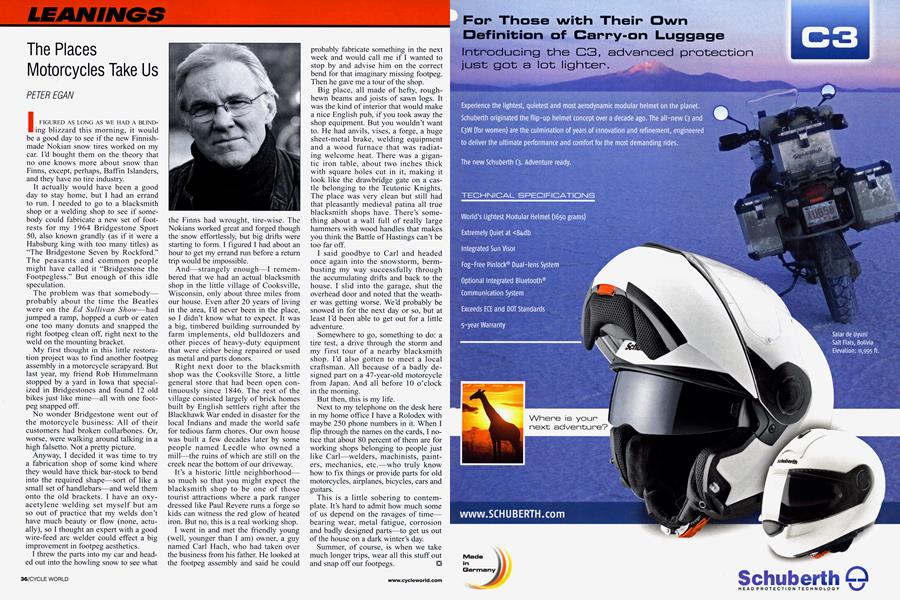
I went in and met the friendly young (well, younger than I am) owner, a guy named Carl Hach, who had taken over the business from his father. He looked at the footpeg assembly and said he could probably fabricate something in the next week and would call me if I wanted to stop by and advise him on the correct bend for that imaginary missing footpeg. Then he gave me a tour of the shop.
Big place, all made of hefty, roughhewn beams and joists of sawn logs. It was the kind of interior that would make a nice English pub, if you took away the shop equipment. But you wouldn't want to. He had anvils, vises, a forge, a huge sheet-metal brake, welding equipment and a wood furnace that was radiating welcome heat. There was a gigantic iron table, about two inches thick with square holes cut in it, making it look like the drawbridge gate on a castle belonging to the Teutonic Knights. The place was very clean but still had that pleasantly medieval patina all true blacksmith shops have. There's something about a wall full of really large hammers with wood handles that makes you think the Battle of Hastings can't be too far off.
I said goodbye to Carl and headed once again into the snowstorm, bermbusting my way successfully through the accumulating drifts and back to the house. I slid into the garage, shut the overhead door and noted that the weather was getting worse. We'd probably be snowed in for the next day or so, but at least I'd been able to get out for a little adventure.
Somewhere to go, something to do: a tire test, a drive through the storm and my first tour of a nearby blacksmith shop. I'd also gotten to meet a local craftsman. All because of a badly designed part on a 47-year-old motorcycle from Japan. And all before 10 o'clock in the morning.
But then, this is my life.
Next to my telephone on the desk here in my home office I have a Rolodex with maybe 250 phone numbers in it. When I flip through the names on the cards, I notice that about 80 percent of them are for working shops belonging to people just like Carl—welders, machinists, painters, mechanics, etc.—who truly know how to fix things or provide parts for old motorcycles, airplanes, bicycles, cars and guitars.
This is a little sobering to contemplate. It's hard to admit how much some of us depend on the ravages of time— bearing wear, metal fatigue, corrosion and badly designed parts—to get us out of the house on a dark winter's day.
Summer, of course, is when we take much longer trips, wear all this stuff out and snap off our footpegs. □