Brake Tech Ceramic Matrix Composite Discs
Brake Tech Ceramic Matrix Composite Discs
CW EVALUATION
Enlightened stopping
LIGHTWEIGHT BRAKE DISCS ARE AS much about going fast as they are about slowing down. The weight of a motorcycle’s brakes, tires and wheels must be accelerated and decelerated twice—with the rest of the machine and rotationally—so reducing wheelrelated mass has a double effect. Plus, any reduction in gyroscopic effect up front brought about by lighter spinning parts makes directional changes easier. Point being, there are big benefits to fitting lightweight brakes.
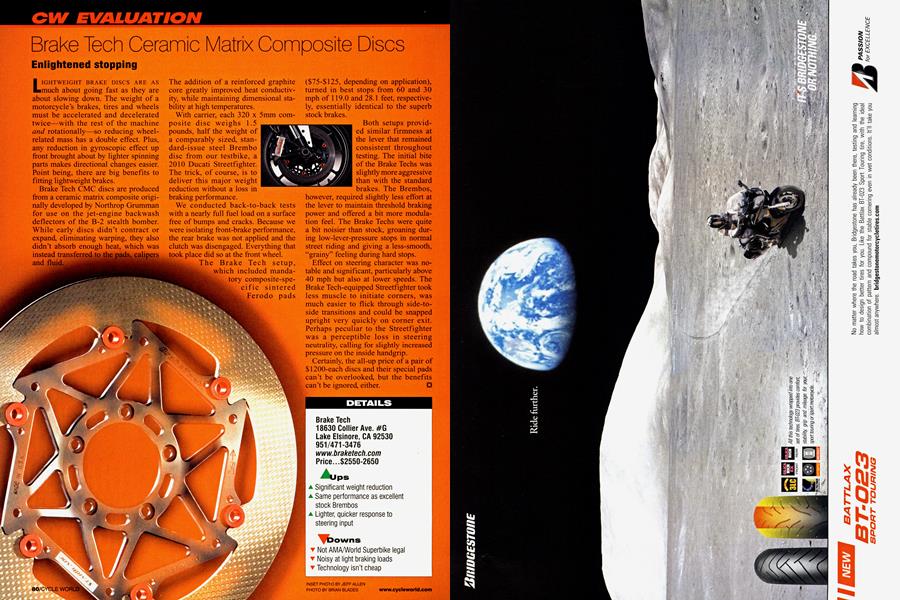
Brake Tech CMC discs are produced from a ceramic matrix composite originally developed by Northrop Grumman for use on the jet-engine backwash deflectors of the B-2 stealth bomber. While early discs didn’t contract or expand, eliminating warping, they also didn’t absorb enough heat, which was instead transferred t and flui
The addition of a reinforced graphite core greatly improved heat conductivity, while maintaining dimensional stability at high temperatures.
With carrier, each 320 x 5mm composite disc weighs 1.5 .pounds, half the weight of a comparably sized, standard-issue steel Brembo disc from our testbike, a 2010 Ducati Streetfighter. The trick, of course, is to deliver this major weight reduction without a loss in braking performance.
We conducted back-to-back tests with a nearly full fuel load on a surface free of bumps and cracks. Because we were isolating front-brake performance, the rear brake was not applied and the clutch was disengaged. Everything that took place did so at the front wheel.
The Brake Tech setup, which included mandatory composite-specific sintered Ferodo pads ($75-$ 125, depending on application), turned in best stops from 60 and 30 mph of 119.0 and 28.1 feet, respectively, essentially identical to the superb stock brakes.
__ Both setups provided similar firmness at the lever that remained consistent throughout testing. The initial bite of the Brake Techs was slightly more aggressive than with the standard brakes. The Brembos, however, required slightly less effort at the lever to maintain threshold braking power and offered a bit more modulation feel. The Brake Techs were quite a bit noisier than stock, groaning during low-lever-pressure stops in normal street riding and giving a less-smooth, “grainy” feeling during hard stops.
Effect on steering character was notable and significant, particularly above 40 mph but also at lower speeds. The Brake Tech-equipped Streetfighter took less muscle to initiate corners, was much easier to flick through side-toside transitions and could be snapped upright very quickly on corner exit. Perhaps peculiar to the Streetfighter was a perceptible loss in steering neutrality, calling for slightly increased pressure on the inside handgrip.
Certainly, the all-up price of a pair of $1200-each discs and their special pads can’t be overlooked, but the benefits can’t be ignored, either.
DETAILS
Brake Tech
18630 Collier Ave. #G Lake Elsinore, CA 92530 951/471-3476 www.braketech.com Price...$2550-2650
Ups
A Significant weight reduction
A Same performance as excellent stock Brembos
A Lighter, quicker response to steering input
Downs
▼ Not AMA/World Superbike legal
▼ Noisy at light braking loads
▼ Technology isn’t cheap