Eastern Promise
EASTERN PROMISE
Two weeks in India on a Royal Enfield in the name of charity
SIMON BOWEN
IT HAD BEEN EXACTLY 10 YEARS SINCE MY LAST VISIT, five years since the first Enduro India charity event and, fittingly, 60 years since India celebrated its independence from the British. Times have changed considerably for this ancient and exotic nation that has embraced the epoch of information technology and is firmly in control of its destiny. On a mission to complete a grueling bike journey as part of a prodigious convoy, I would soon discover how little an effect “New India” has had on the masses.
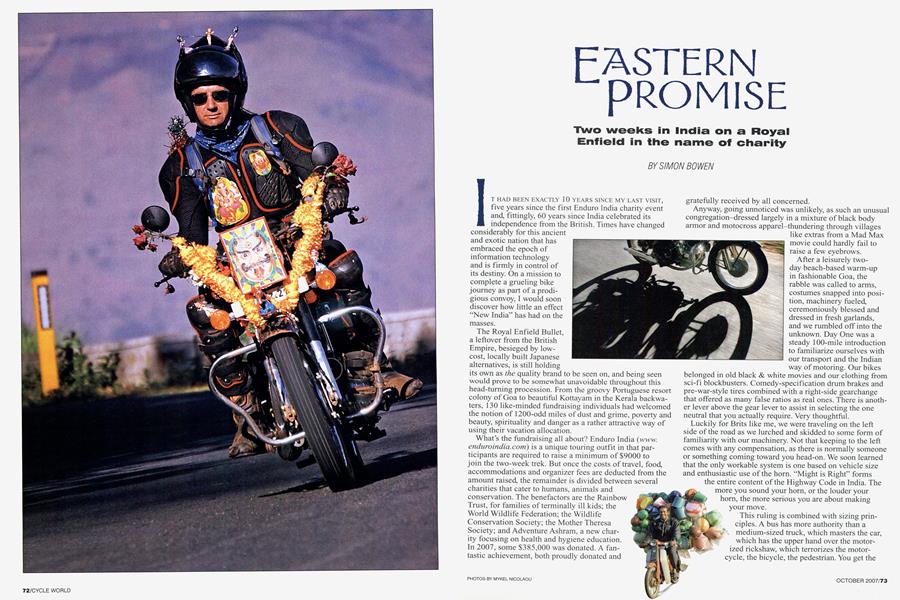
The Royal Enfield Bullet, a leftover from the British Empire, besieged by lowcost, locally built Japanese alternatives, is still holding its own as the quality brand to be seen on, and being seen would prove to be somewhat unavoidable throughout this head-turning procession. From the groovy Portuguese resort colony of Goa to beautiful Kottayam in the Kerala backwaters, 130 like-minded fundraising individuals had welcomed the notion of 1200-odd miles of dust and grime, poverty and beauty, spirituality and danger as a rather attractive way of using their vacation allocation.
What’s the fundraising all about? Enduro India (www. enduroindia.com) is a unique touring outfit in that participants are required to raise a minimum of $9000 to join the two-week trek. But once the costs of travel, food, accommodations and organizer fees are deducted from the amount raised, the remainder is divided between several charities that cater to humans, animals and conservation. The benefactors are the Rainbow Trust, for families of terminally ill kids; the World Wildlife Federation; the Wildlife Conservation Society; the Mother Theresa Society; and Adventure Ashram, a new charity focusing on health and hygiene education.
In 2007, some $385,000 was donated. A fantastic achievement, both proudly donated and
gratefully received by all concerned.
Anyway, going unnoticed was unlikely, as such an unusual congregation-dressed largely in a mixture of black body armor and motocross apparel-thundering through villages
like extras from a Mad Max movie could hardly fail to raise a few eyebrows.
After a leisurely twoday beach-based warm-up in fashionable Goa, the rabble was called to arms, costumes snapped into position, machinery fueled, ceremoniously blessed and dressed in fresh garlands, and we rumbled off into the unknown. Day One was a steady 100-mile introduction to familiarize ourselves with our transport and the Indian way of motoring. Our bikes
way of motoring. Our bikes belonged in old black & white movies and our clothing from sci-fi blockbusters. Comedy-specification drum brakes and pre-war-style tires combined with a right-side gearchange that offered as many false ratios as real ones. There is another lever above the gear lever to assist in selecting the one neutral that you actually require. Very thoughtful.
Luckily for Brits like me, we were traveling on the left side of the road as we lurched and skidded to some form of familiarity with our machinery. Not that keeping to the left comes with any compensation, as there is normally someone or something coming toward you head-on. We soon learned that the only workable system is one based on vehicle size and enthusiastic use of the horn. “Might is Right” forms the entire content of the Highway Code in India. The more you sound your horn, or the louder your horn, the more serious you are about making your move.
This ruling is combined with sizing principles. A bus has more authority than a " , medium-sized truck, which masters the car, which has the upper hand over the motorized rickshaw, which terrorizes the motorcycle, the bicycle, the pedestrian. You get the
picture. You also have to learn quickly and have sharp reflexes, as it’s not uncommon to find four different-sized vehicles and two cows coming toward you at once. That mastered, you can sit back and kind of relax.
Day One ends with little in the way of problems, though we are 11 riders short, still out on the road, as we settle for dinner. We haven’t even sniffed the real India yet as we all collapse into our respective beach huts, ready for another helping of this strange place.
By Day Three, I’ve mastered the Enfield. The art is patience and cunning, not revs. Deviant swerves and gentle cog-swapping are preferable to high speed. We’re generally hovering between 40-50 mph, as any faster would threaten the rider’s dignity and livelihood. The run from Shimoga to Silent Valley on Day Four opens the eye to increased greenery. Every sense becomes overloaded as we inhale the smells, sights and sounds of our surroundings.
India is crammed with industrious and resourceful people. Villages and towns are full of people going about their business. In between villages are roadside stalls selling tea, coconut, sugarcane juice.. .and mobile-phone accessories. Even the rural areas seem busy.
Wherever we go there are people, either bemused, intrigued or full of questions. They are all smiling and friendly, wanting to shake your hand, ask where you are heading or wish you good luck. Don’t mention cricket,
I soon learned, or escape becomes impossible. Kids line the street to wave and cheer us on-this must be the happiest place on Earth. The vast majority are poor and yet very rarely do we see anyone with their hand held out expecting charity. The humbling nature of this experience has unveiled itself and is touching beyond belief. The only currency dispensed by us is pens to grateful children; the pleasure this generates is heart-warming, a small gesture meaning everything.
A changing India means that roads are far better than on my last visit. The hustle and bustle of the carriageways is full-on but tempered by fresh tarmac on the highways that gives the opportunity to enjoy the ever-improving scenery in some comfort. The Enfield chugs on regardless, and I’m developing a harmony with my personal museum piece. It has a comfortable riding position and a decent seat, and that’s
about it. No frills offered and none required. Not too much vibration but enough to provide a friendly character. This is motorcycling at its most basic, and I wouldn’t want to experience this country on anything else.
For animal lovers and conservationists, the trip is about to become more interesting. We leave the stunning city of Mysore heading toward Jungle Hut, a tiger and elephant retreat in
Masinagudi, where we are to enjoy two nights and a welcome day of rest. Not before one of the party (a dairy farmer from England, ironically) managed to hit a cow head-on in the heavy morning traffic. We’re reminded that there are two motoring crimes that are generally not tolerated in this country. Hitting or killing a cow or child can result in on-the-spot justice of an unpleasant and possibly
fatal nature. A mob soon gathered and 10,000 rupees ($250) had to change hands in front of the local constabulary before we could continue our journey. The poor sacred beast couldn’t stand on its feet and was soon slaughtered on the spot. A particularly distressing start to the day for all concerned, and we proceeded cautiously on our short journey ahead.
Many of us get to stay in tree huts
and enjoy the surreal proceedings of a religious carnival nearby.
Religious fervor was at full flow. An array of colors and smells assaulted the senses.
Apocalyptic drumming, chanting, singing and stallholders shouting at prospective customers filled the night. Despite the madness, the overriding sense of friendliness was everywhere. Safari trips and visits to old
British hill stations were available, with a well-stocked bar and stunning food to round off proceedings and recharge flagging batteries.
We head hungover to the mountain and on toward Oooty and eventually Kodakanal. We know this is going to
be special because it’s a secret road, closed to foreigners since the 1960s, that we have been given special permission to ride, and it contains more hairpins than is possible to count. For most of the Bullet 350 riders, this was to be the greatest day ever spent on two
wheels. Some bikes malfunction but are quickly resurrected by the traveling mechanics. A few riders suffer from dehydration and take longer to fix.
Just as you think the trip has peaked, it gets better. The route is very carefully planned to ensure that your mind is constantly overloaded. After two hours descending the mountain from Kodai, we encounter a horizon filled with cultivated green hills, immaculate tea plantations, rivers and waterfalls. Then more wildlife reserves, switchbacks and perfect road surfaces, never too far from tigers, bears and hyenas. I’ve seen a lot of the world, but I’ve never seen this, motorcycling that brings a tear to the eye of every rider. From Munnar, we ride through spice plantations and more tiger reserves on the penultimate leg.
Journey’s end is near. It’s already the last day of riding, and despite a level of fatigue among the riders, nobody wants this adventure to end. It’s not another bike trip in another country. It’s an epic journey in another world. For most, thoughts of home and all the worries of modern life have been banished. The bigger picture is here, and we’ve seen it together. The sense of camaraderie is intense as we swallow hard and head off to complete the last stretch. Not everybody made the finish. Some fell through injury or illness. It’s not a walk in the park. Those who made it will never forget it. Some will never be the same again.
Simon Bowen travels globally for various bike manufacturers as a hired riding hand when not developing a chassis setup program for a MotoGP team and generally avoiding work in the pursuit of motorcycling nirvana.