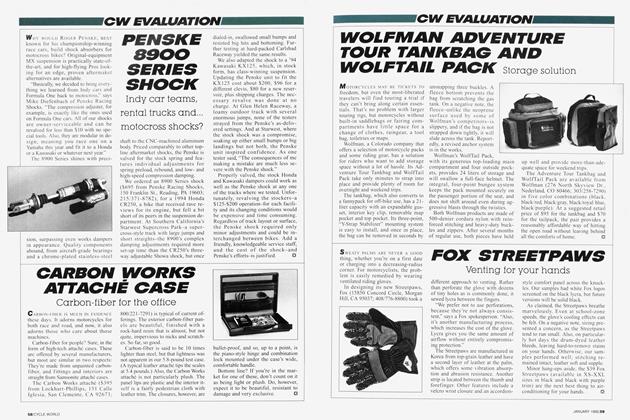
Chatterbox Gmrs X1 Two-Way Radio
ChatterBox GMRS X1 Two-Way Radio
Can you hear me now?
CW EVALUATION
IF YOU HAVE EVER RIDDEN A MOTORcycle in a group or with a passenger, you know how difficult clear communication can be. Does that hand signal mean, "I've got to pee," "I need gas" or "That way to China"? Hard to tell.
Additionally, there are dangers on the road, situations when a little voice in your ear, with the right message, could reduce your risk on the motorcycle. As in, risk of getting separated (“This is our exit.”); risk of road rash (“There’s sand in the corner after the bridge.”); risk of connubial cut-off from your pillion partner (“You’re going too fast!”); risk of financial ruin (“5-0 under the overpass!”). You get the idea. It’s in situations like these where the ChatterBox GMRS X1 personto-person sports-communication system can help.
Effectively a walkie-talkie designed for motorcycle use, the XI claims a 5-mile range and incorporates useful features like a remote push-to-talk button, inputs for cell phone and portable music device (think MP3 player) and an intercom for communicating with passenger. There is
also a voice-activation mode for handsfree operation.
The unit attaches to the left side of a full-face helmet using a plastic bracket that allows the device to be removed with a simple push of a release tab.
The unit itself mounts easily, but headset installation is slightly more difficult. The provided stereo speakers and noise-reducing microphone slipped into an HJC CL-15 helmet with no prob lems, as the helmet’s liner is designed to accept speakers and even has provision to hold them in place. Headset installation in an AGV helmet required modifying the removable cheek pad liners to keep the speakers from causing painful pressure against the ear. Still, while it may take some time and modification to make them comfortable, the speakers should fit into virtually any fullface helmet. Concerns that the transceiver’s placement would have ill effects were unfounded-it’s lightweight, low-profile and unnoticeable while rid-
ing
Using the GMRS XI, though, proved to be a mixed bag. Low-speed function, below 45 mph, was adequate to good for both rider-to-rider and rider-topassenger communication. The voice-activated (VOX) mode functioned well in that speed range but required manual adjustment of the sensitivity settings for every 10 mph change in speed to avoid wind-induced activation. Push-to-talk (PTT) use needed no fine-tuning, but the remote button requires a wire between helmet and handlebar. Worse, active use of the PTT button on the unit itself with gloved hands led to a broken mounting bracket.
Above 70 mph, VOX was near-useless. Using the lowest sensitivity setting required screaming to activate the mic, resulting in garbled messages and sore throats. Sound amplification up to 80 mph was adequate; music and some verbal communication were audible at maximum volume, even with earplugs.
So, though it might not be the best choice for the speed demons among us, for urban riders cruising their local Sport Bike Nights and “stuntas” looking for real-time instruction from their wheelie coaches, the ChatterBox sure beats hand signals.
ChatterBox USA 16918 Edwards Rd. Cerritos, CA 90703 888/452-2269 www.hjc-chatterbox.com Pricg~. .$330
!Y Ups F A 40 mph: "I can hear you now" A One-year "no questions" warranty A Highly conspicuous mounting location
VDowns 90 mph: "I can't hear you now" How much?! Highly conspicuous mounting location