Tdc
TDC
Sideways suspension comes of age
Kevin Cameron
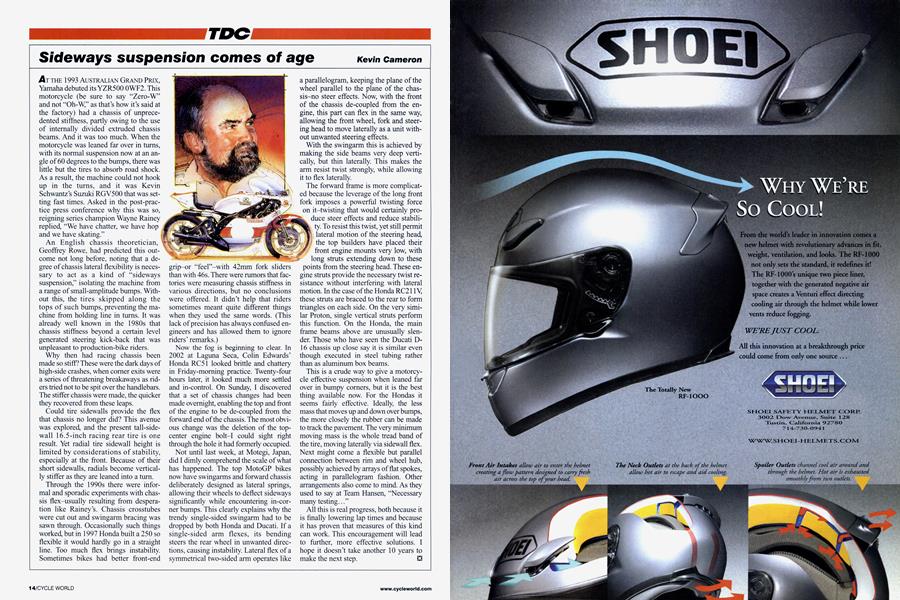
AT THE 1993 AUSTRALIAN GRAND PRIX, Yamaha debuted its YZR500 0WF2. This motorcycle (be sure to say “Zero-W” and not "Oh-W," as that’s how it’s said at the factory) had a chassis of unprecedented stiffness, partly owing to the use of internally divided extruded chassis beams. And it was too much. When the motorcycle was leaned far over in turns, with its normal suspension now at an angle of 60 degrees to the bumps, there was little but the tires to absorb road shock. As a result, the machine could not hook up in the turns, and it was Kevin Schwantz’s Suzuki RGV500 that was setting fast times. Asked in the post-practice press conference why this was so, reigning series champion Wayne Rainey replied, “We have chatter, we have hop and we have skating.”
An English chassis theoretician, Geoffrey Rowe, had predicted this outcome not long before, noting that a degree of chassis lateral flexibility is necessary to act as a kind of “sideways suspension,” isolating the machine from a range of small-amplitude bumps. Without this, the tires skipped along the tops of such bumps, preventing the machine from holding line in turns. It was already well known in the 1980s that chassis stiffness beyond a certain level generated steering kick-back that was unpleasant to production-bike riders.
Why then had racing chassis been made so stiff? These were the dark days of high-side crashes, when comer exits were a series of threatening breakaways as riders tried not to be spit over the handlebars. The stiffer chassis were made, the quicker they recovered from these leaps.
Could tire sidewalls provide the flex that chassis no longer did? This avenue was explored, and the present tall-sidewall 16.5-inch racing rear tire is one result. Yet radial tire sidewall height is limited by considerations of stability, especially at the front. Because of their short sidewalls, radiais become vertically stiffer as they are leaned into a turn.
Through the 1990s there were informal and sporadic experiments with chassis flex-usually resulting from desperation like Rainey’s. Chassis crosstubes were cut out and swingarm bracing was sawn through. Occasionally such things worked, but in 1997 Honda built a 250 so flexible it would hardly go in a straight line. Too much flex brings instability. Sometimes bikes had better front-end grip-or “feel”-with 42mm fork sliders than with 46s. There were mmors that factories were measuring chassis stiffness in various directions, but no conclusions were offered. It didn’t help that riders sometimes meant quite different things when they used the same words. (This lack of precision has always confused engineers and has allowed them to ignore riders’ remarks.)
Now the fog is beginning to clear. In 2002 at Laguna Seca, Colin Edwards’ Honda RC51 looked brittle and chattery in Friday-morning practice. Twenty-four hours later, it looked much more settled and in-control. On Sunday, I discovered that a set of chassis changes had been made overnight, enabling the top and front of the engine to be de-coupled from the forward end of the chassis. The most obvious change was the deletion of the topcenter engine bolt-I could sight right through the hole it had formerly occupied.
Not until last week, at Motegi, Japan, did I dimly comprehend the scale of what has happened. The top MotoGP bikes now have swingarms and forward chassis deliberately designed as lateral springs, allowing their wheels to deflect sideways significantly while encountering in-corner bumps. This clearly explains why the trendy single-sided swingarm had to be dropped by both Honda and Ducati. If a single-sided arm flexes, its bending steers the rear wheel in unwanted directions, causing instability. Lateral flex of a symmetrical two-sided arm operates like a parallelogram, keeping the plane of the wheel parallel to the plane of the chassis-no steer effects. Now, with the front of the chassis de-coupled from the engine, this part can flex in the same way, allowing the front wheel, fork and steering head to move laterally as a unit without unwanted steering effects.
With the swingarm this is achieved by making the side beams very deep vertically, but thin laterally. This makes the arm resist twist strongly, while allowing it to flex laterally.
The forward frame is more complicated because the leverage of the long front fork imposes a powerful twisting force it-twisting that would certainly produce steer effects and reduce stability. To resist this twist, yet still permit lateral motion of the steering head, the top builders have placed their front engine mounts very low, with long struts extending down to these points from the steering head. These engine struts provide the necessary twist resistance without interfering with lateral motion. In the case of the Honda RC21IV, these struts are braced to the rear to form triangles on each side. On the very similar Proton, single vertical struts perform this function. On the Honda, the main frame beams above are unusually slender. Those who have seen the Ducati D16 chassis up close say it is similar even though executed in steel tubing rather than as aluminum box beams.
This is a crude way to give a motorcycle effective suspension when leaned far over in bumpy comers, but it is the best thing available now. For the Hondas it seems fairly effective. Ideally, the less mass that moves up and down over bumps, the more closely the rubber can be made to track the pavement. The very minimum moving mass is the whole tread band of the tire, moving laterally via sidewall flex. Next might come a flexible but parallel connection between rim and wheel hub, possibly achieved by arrays of flat spokes, acting in parallelogram fashion. Other arrangements also come to mind. As they used to say at Team Hansen, “Necessary many testing...”
All this is real progress, both because it is finally lowering lap times and because it has proven that measures of this kind can work. This encouragement will lead to further, more effective solutions. I hope it doesn’t take another 10 years to make the next step. □