Motogp
MOTOGP!
RACE WATCH
The new era begins with four-strokes--and Rossi-at the front
MICHAEL SCO1T
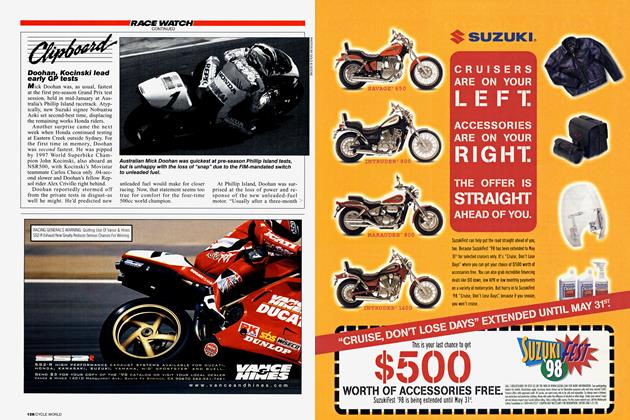
MISSION IMPOSSIBLE? THAT'S WHAT Yamaha's new YZR-M1 Ibur-stroke had been unkindly indly nicknamed alter it was beaten twice by old-guard 5OOcc two-strokes at preseason tests. It was a play on Mission I ," the meaning for M1 purveyed by Yamaha's PR machine, that number-one mission being winning the MotoGP World Championship. Rut at the seasonopening Japanese Grand Pnx-on the famed Suzuka circuit-a sudden turnaround in final qualifying, put Carlos Checa's Marlboro-orange bike on the Front row of the grid, and he finished third in the race.
Perhaps riot M ssion I , hut Mission Aceonipushed, al least! (ertainly the lag could he ap plied to Just about every facet of the new era of Grand Prix four-strokes.
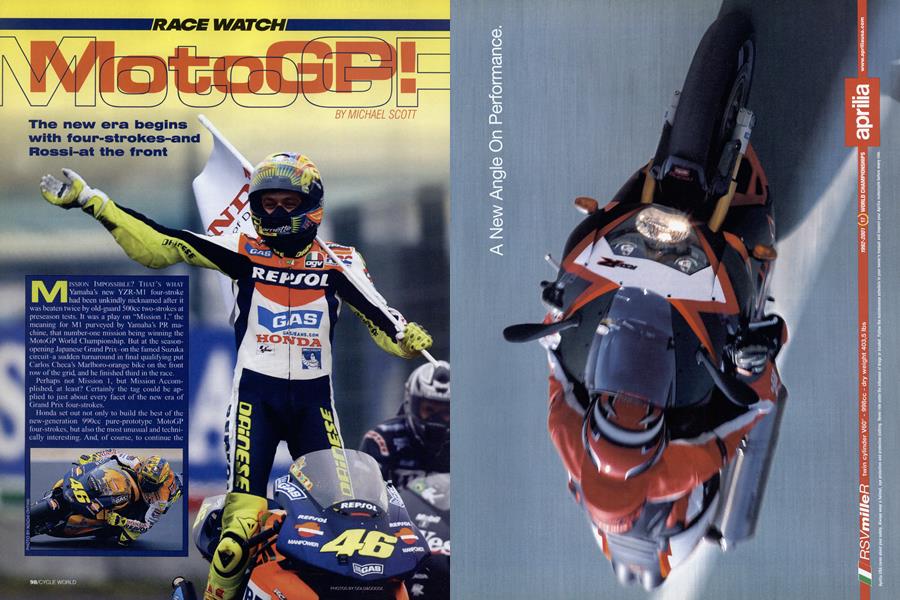
I londa ct out not only to bu i Id I he best ol the new-generation 990cc pure-prototype Moto( iP f~ur-str ,kes, hut a I SO the m )St unusual and tech n i -cally interesting. And, of course, to continue the domination Big Red's twostrokes had achieved in the old 500cc class. Pole position and the narrow first-race win in the hands of reigning World Cham pion Valentino Rossi proved the point. Even if only just.
Suzuki had rushed out its new big bad baritone V-Four a full year early. Lead rider Ken ny Roberts Jr., world champ on Suzuki's fading two-stroke two years before, muttered darkly about there being a long way to go before it would be competi tive. But with Japanese wildcard Akira Ryo on board, the bike proved surprisingly good, as Ryo led two-thirds of the race and took second place.
Aprilia's even later-arriv ing Triple, while rather rough around the edges, was not only fast but also finished its first race-in the top 10, no less.
The mission was accomplished also in the larger sense, as intended by the big-factory architects of the new regime in GP racing. The two-strokes were beaten-the best-placed was Non fumi Abe's Yamaha YZR500 in fifth. And the hoped-for surge of general (and technical) interest for this big break with history was rewarded with unprecedented media coverage.
And how about new American hope ful John Hopkins, hailed (in admittedly rather limited circles) as "the new Kevin Schwantz?" Well, like Schwantz, Hoppie crashed in his first GP. Twice. But he got back on twice, stopped in the pits for a new Red Bull Yamaha fairing and rejoined once more, shift ing gears with his hand. And finished 12th in his first GP. Okay, he was five laps down, and last. But he got the points anyway.
The fact that the first race of the new era was streaming wet, and that there were only 12 finishers, with eight big-name riders taking the mud-slide route, didn't really matter. Certainly, it changed things, helping some and hin dering others. Take Loris Capirossi on the two-stroke Honda NSR500: He was only just knocked off pole posi tion in dry qualifying, but completely frustrated by wheelspin in the wet race, finishing a lap behind in ninth place. Ryo's throttle-friendly Suzuki and new Dunlop tires, meanwhile, were given a big boost right to the front of the field. But while the cast list of leading players might have been slightly different on a dry track, the racing was still amazingly tight.
Qualifying put the new machines and their two-stroke rivals under a different sort of scrutiny. Times were remark ably close, given the new diversity of machinery. Not only were there 12 rid ers within a second of Valentino Rossi's pole-at a 3.6-mile-long track with a 2minute-plus lap time, don't forget-but they rode five very different types of achines, covering the range of two stroke and four-stroke. Even the no hopers were fast: All 21 qualifiers were within 3 seconds of pole, the closest ever qualifying grid in the 53-year his tory of the premier GP class.
The new MotoGP formula was de vised as much as anything out of desperation by the racing manu facturers, who were facing the stagnation of the traditional 500cc class. Two-strokes came to dominate and led to a genera tion of pure racing bikes nothing like the streetbikes the factories built for sale. Four-strokes put the cutting edge of technical de velopment back in the mainstream for their engineers, and offer a new pinnacle toward which all those Superbike-based national championship riders can aim. -
It was the manufacturers, through their Motor Sports Manufacturers As sociation, who drew up the rules, and in such a way as to please almost all of them. As well as the four already in GPs (Honda, Yamaha, Suzuki and Aprilia), the committee also included Kawasaki and Ducati. Both of the lat ter have promised to join the party
next year; likewise (though rather im plausibly) MZ. Sauber, meanwhile, has an engine built, running and awaiting customers, and even BMW has re peatedly been obliged to deny rumors that it is preparing for its own return to GP racing after an absence of some 50 years.
In detail, the rules offer different min imum weight limits for different cylin der numbers-500cc two-strokes at 220/ 254/287 pounds for two/three/four cylinder bikes, respectively, while 990cc> four-strokes are allowed 298/320/342 pounds for up to three/five/six or more cylinders. A revision bumps oval-piston four-strokes up to the next weight cate gory, but there aren't any at present, so it hardly matters. The four-strokes also have a smaller maximum fuel-tank ca pacity: 6.3 gallons versus a two-stroke's allowable 8.5.
The catch-all capacity limit is a quirky 990cc (why not a full liter?), with the insistence that the machines be true prototypes, with no productionbased parts or even measurements.
One thing was clear from the start: With this engine size, it would be rela tively easy to make enough horsepower to overwhelm current and even nearfuture tire and chassis technology. En gines, therefore, could be relatively understressed: The more extreme For mula One car technology, such as pneumatic valve "springs," ultra-com plex electronics and rev ceilings push ing 20,000 rpm, simply wouldn't be necessary to be competitive. Some where around 210 horsepower was thought to be more than enough, and easily achievable.
One side effect was to reduce the usual tendency for just one type of en gine to work better than all others. De signers have chosen three (Aprilia, Sauber), four (Yamaha, Suzuki, Kawa saki, Ducati and MZ) and five (Honda) cylinders, in inline or Vee configura tions-a happy outcome for connoisseurs of the exhaust-pipe orchestra. The van ous shrieks, howls and gutsy throbs were a source of delight at Suzuka, and underlined how homogenized and (face it) dull the two-strokes had become.
Honda's factory squad fields Rossi and Tohru Ukawa-plus, at Suzuka, wild card Shinichi Itoh, tester for the new V Five; Yamaha has Max Biaggi and Car los Checa; Roberts and Sete Gibernau ride for Suzuki, joined here by factory tester and All-Japan Superbike champ Ryo; and Aprilia's single entry (so far) goes to Frenchman Regis Laconi. The two-strokes, of course, haven't gone away-they've just been dropped from the agendas of the top factory teams. Yamaha still supplies three cus tomer teams with what are basically last year's bikes: Red Bull with riders Garry McCoy and Hopkins; Gauloises Tech3 with Shinya Nakano and Olivier Jacque; and Antena 3 with Abe and last-minute Alex Criville-replacement Riba. Honda served its customers rather better with upgraded NSR500s fôr Daijiro Katoh, Capirossi, Alex Bar ros and Tetsuya Harada, plus Team Kanemoto's Jurgen van den Goor bergh. Kenny Roberts Sr.'s three-cylin der Proton soldiers on for another year with new riders Jeremy McWilliams and Nobuatsu Aoki.
Rossi's expected dominant start was spoiled by crashes on both qualifying days-his own fault, he admitted, victim over-abundant confidence. Instead, it was Capirossi who set the practice pace on the slightly revised and uniquely fig ure-eight Suzuka track. Then, both Yamahas challenged, plus Ryo's Suzu ki. In the end, the front row comprised Rossi, on pole at the very last gasp, then Capirossi, Itoh and Checa.
The rain changed everything for the race, and when Ryo's Suzuki bellowed away up front, neither Rossi nor Itoh seemed able to do anything about it. Then, Gibernau brought the second Suzuki through to challenge for the lead. Riding with a huge degree of dar ing, he suddenly found Rossi in his way mid-corner, touched the brakes and was down. Easily done: By then, McCoy, Hopkins, van den Goorbergh, Biaggi and Roberts had already fallen foul of the conditions. The rain helped the Team Roberts Proton riders, however. McWilliams qualified last but was up to seventh-then he, too, slipped off.
All weekend, there were fascinating things to be seen. One was how the Suzukis might have had less all-up power than the Hondas, but were clear ly easier to manage. Time and again, Ryo would surge away from Rossi out of the bends. "I just couldn't open the throttle as early as him," explained Rossi later.
Another was the sheer speed of the V Five Hondas. By the end of the straight, Rossi would be breathing down Ryo's neck, and this was how he finally got by. Rossi's bike was fastest of the field, clocked at a 196-mph best, while Ryo's Suzuki only managed 10th-fastest peak at 188 mph. Another illustration of bike difference was a battle between former winner Abe's two-stroke Yamaha and Ukawa's V-Five Honda. Abe was all over his countryman into, through and out of the turns, and frequently passed him there. Ukawa, on the other hand, y The Yamahas were consistently slow by comparison Biaggi was a lowly 18th fastest on the radar gun with a peak of "only" 186 mph, while Checa was slightly better off at 188. Peak • speed wasn't so impressive, but lap times were improved by a new chassis with revised weight distribution, which
was able to motor past at will as soon as the track straightened out. But only un til he also fell off.
Speed isn't everything-though it is a handy measure of horsepower. Consider the Aprilia: Blustering into the turns, and popping and banging through them, it was something of a handful. Down the straight, though, only the best Hondas were faster through the speed traps, as Laconi was fifth fastest with a reading of 190 mph. Clearly, there's a lot of k~: potential here.
allowed the disgruntled riders to make a leap in qualifying. Ultimately, both rode the old chassis for the race, with their
new bikes set up for a possible dry af ternoon that didn't happen-but wet con ditions throw it back to the rider rather than the finer points of chassis tuning, and Checa rose to the challenge to claim third from Itoh's faster Honda.
There were still many questions re maining after this first race, as the transi tion season stretched ahead. Suzuki's technical guru Warren Willing com pared data-logging from fast laps by Roberts on the two-stroke last year and the four-stroke this year. The old bike was consistently 1 to 3 mph faster at almost every corner apex, and slightly quicker in acceleration in the bottom gears, thanks to a bet ter power-to-weight ratio. In third and fourth gears, the four-stroke's extra 11 horsepower began to tell, and it would grab back chunks of speed and distance. ..
Not every circuit offers that kind of " acceleration, however, as Willing explained. Not Welkom in South Africa, nor Valencia or Estoril, where the two-strokes had beaten the Yamaha four-stroke in tests. Jerez and Donington Park are also interesting cases, both relatively slow and techni cal. At the tracks with higher speeds, however, the four-strokes should pile on the wins. Even more interesting are Assen and Phillip Island-both offer high speeds, but the corners run one into the next, and riders seldom use full throttle. Despite all this, Rossi is extremely good, and so is his Honda, which is like ly to have the throttle-response glitches riders have complained about fixed sooner rather than later.
The omens are good: The first race of the new page of history was a stunner. Let's hope it carries on the same way.