Cilpboard
Cilpboard
RACE WATCH
Safety issues simmer at Loudon
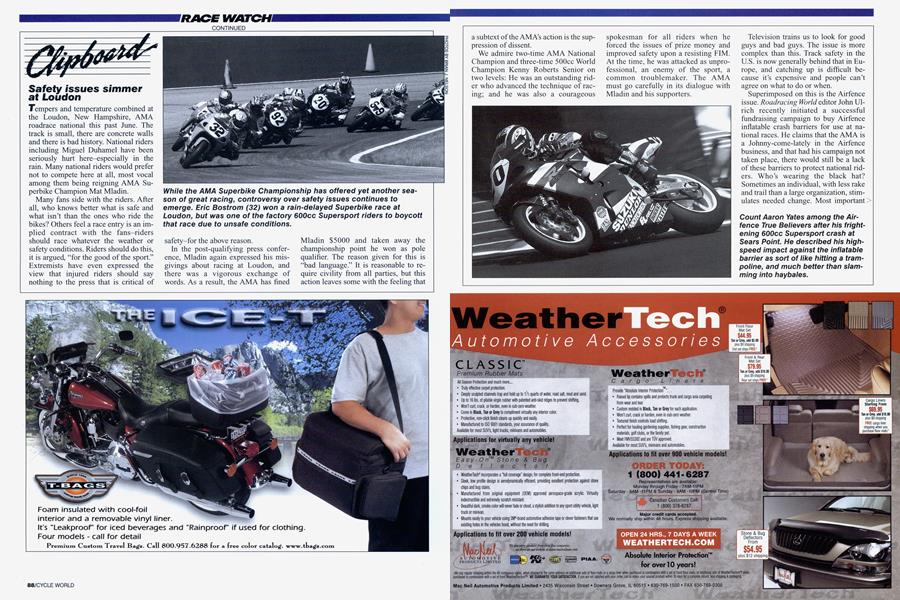
Tempers and temperature combined at the Loudon, New Hampshire, AMA roadrace national this past June. The track is small, there are concrete walls and there is bad history. National riders including Miguel Duhamel have been seriously hurt here-especially in the rain. Many national riders would prefer not to compete here at all, most vocal among them being reigning AMA Superbike Champion Mat Mladin.
Many fans side with the riders. After all, who knows better what is safe and what isn’t than the ones who ride the bikes? Others feel a race entry is an implied contract with the fans-riders should race whatever the weather or safety conditions. Riders should do this, it is argued, “for the good of the sport.” Extremists have even expressed the view that injured riders should say nothing to the press that is critical of safety-for the above reason.
In the post-qualifying press conference, Mladin again expressed his misgivings about racing at Loudon, and there was a vigorous exchange of words. As a result, the AMA has fined
Mladin $5000 and taken away the championship point he won as pole qualifier. The reason given for this is “bad language.” It is reasonable to require civility from all parties, but this action leaves some with the feeling that a subtext of the AMA’s action is the suppression of dissent.
We admire two-time AMA National Champion and three-time 500cc World Champion Kenny Roberts Senior on two levels: He was an outstanding rider who advanced the technique of racing; and he was also a courageous spokesman for all riders when he forced the issues of prize money and improved safety upon a resisting FIM. At the time, he was attacked as unprofessional, an enemy of the sport, a common troublemaker. The AMA must go carefully in its dialogue with Mladin and his supporters.
Television trains us to look for good guys and bad guys. The issue is more complex than this. Track safety in the U.S. is now generally behind that in Europe, and catching up is difficult because it’s expensive and people can’t agree on what to do or when.
Superimposed on this is the Airfence issue. Roadracing World editor John Ulrich recently initiated a successful fundraising campaign to buy Airfence inflatable crash barriers for use at national races. He claims that the AMA is a Johnny-come-lately in the Airfence business, and that had his campaign not taken place, there would still be a lack of these barriers to protect national riders. Who’s wearing the black hat? Sometimes an individual, with less rake and trail than a large organization, stimulates needed change. Most important is that the equipment was in place for Aaron Yates’ recent 100-mph crash in Turn 10 at Sears Point, historically one of the most dangerous corners on the AMA circuit.
“It was good,” he told me with his signature Yates look of assured, pleasant calm. After he’d fallen and was sliding, he looked around to see where he was going but got turned around and hit the barrier headfirst.
“After I stopped moving and kind of came down on the ground, I lay there and checked my arms and legs to see if I was all right. I was, so I got up.”
Everything has strengths and weaknesses. Airfence is best, cornerworkers say, when you hit straight on. When you hit at an angle, it can pull you in, and contact with footpegs and other projections rips Titanic-style holes in the fence, rendering it useless. In one case, a bike buried itself at the overlap between two Airfence sections and caught fire. This burned holes in the fence, releasing two jets of air to fan the flames. Airfence is not a cure-all, but let’s be glad it was there to catch Yates, and will be there for future crashes.
Riders are intense characters who have to win. It’s unwise to build up heart-warming romantic illusions of what they ought to be. Mladin seems to be irritated by all other males, as if to say, “What’re you doing here? What’s your excuse to exist?” But that’s the competitive personality at work. Racing insiders know it well. Ever since the beginning of racing, top riders have tried to psyche each other out, and Mladin is a master. In Saturday’s qualifying at Loudon, here came Kawasaki’s Eric> Bostrom into Turn 10. Bostrom’s corner speeds are very high, his bike far over, he far off the bike, holding it up on the flatter part of its tires. He had been graceful and smooth throughout the weekend. Now here came Mladin, rushing up behind him, shouldering past. It was a classic ego put-down.
Except it didn’t work. Yes, Bostom had been slow onto the straight off Turn 12, and it was tempting to see in this a reason why Mladin was on pole and not Bostrom. But in the race, Bostrom led off the grid and, save for some highpressure forced passes by Mladin, led all the way to the finish. When you pit two competitive personalities directly against each other, the psychological stuff cancels. Riding harder has long been Mladin’s strength-his physical condition is so high that he can always dig deeper and outpush others. Not at Loudon. Rushing into Turn 3, a firstgear near-180-degree right-hander, Mladin pushed past Bostrom but then faced the classic outbraker’s problemarriving too hot to hold the line. So, Mladin had to tip-toe around the outside while Bostrom got a solid drive back into the lead. Third was Yates, whose set-up and style seem to have benefited from the Road Atlanta test earlier this season. His manager, ClifFNobles, said, “I think he’s finally coming around to Ammar’s way.” This refers to the physics-based style of data collection, analysis and set-up practiced by the team’s instrumentation chief, Ammar Bazazz. Yes, all teams have data acquisition and computers, but they don’t have Bazazz.
Kawasaki Superbikes have won many races at Loudon, a track that suits their strengths of quick rollover and the ability to throttle-steer smoothly. A problem all teams faced was how to both have their bikes stiff enough to maneuver quickly on this tight course, and soft enough to absorb the upsetting pavement transitions between oval and road course. Mladin seemed almost to be using his legs as a supplementary suspension, taking his weight on his feet over the transitions while throttling-up. Bostrom did most of this roll-on after the Turn 12 transition, but still had good speed at the far end. Yates planned the left-right-left at this point such that he had throttle on long before any other rider. Watching all this, it’s impossible not to assemble in your mind a “composite all-star rider”-someone with all the strengths and none of the weaknesses we see out there.
The Honda RC51s have had traction problems since the middle of last season. They were on view here, with both bikes looking stiff, breaking away and spinning the rear. Duhamel rode as if something were hurting him, strangely taking big handfuls of throttle and brake alternately in corners. Nicky Hayden did well to push his Honda into fourth by hard riding. Pascal Picotte, always riding as if it were contract time, got his Harley-Davidson VR1000 as high as fourth before crashing out. He rode what was left of it into 18th place.
Yamaha lost its miracle man, Anthony Gobert, to a crash in practice. At first he was wearing one sling, but by late Sunday had one for each arm to support his broken wrist and separated shoulder. Everyone had looked forward to his mysterious excellence, which somehow works on all motorcycles.
As last year, Sunday’s Superbike race was delayed by rain until Monday. The 600cc Supersport final ran on Sunday as planned, but with the national stars choosing to sit out because they thought the wet conditions unsafe-an impressive show of solidarity.
Will there be a Spring Loudon AMA National next year? That was the question last year. Established races like this one, drawing huge crowds to the area, are few enough as it is. Expect every effort to be made to continue a tradition of almost 80 years. -Kevin Cameron
World riders on trial in America
Observed trials isn’t really that, uh, observed here in the U.S. Still, some 5000 people were on hand to witness the world’s best riders levitating themselves and their motorcycles repeatedly at the U.S. round of the World Trials Championship held in Goldendale, Washington. Among them was reigning world champ Doug Lampkin, on yet another title-winning tear. His visit to America, while marked by a little hiccup on Day One of the two-day event, was just one more opportunity for the British rider to show his dominance of the sport. For the small-but-fervent group of American trials lovers, it’s the one chance they get to see the top riders seemingly defy gravity.
Fifteen sections were laid out through and over big rocks, huge rocks and rocks even bigger than those. That which wasn’t the abundant and grippy granite was loose soft dirt that offered virtually no traction. The difficult conditions forced constant adaptation. Faced head-on with vertical faces up to 12 feet and bumpy rock-strewn approaches that seemed cruelly short, the best in the world showed cojones (and skill) of grand scale. Gathering as much momentum as possible in the face of dicey traction, they converted forward motion into near vertical floatation, all in one fluid transition. It was a remarkable show of technique and skill, and the process is deceptively smooth. We’ve all seen motocrossers fly over vast expanses of real estate, and our brains can wrap around the concept of velocity and sizable ramps to explain flight. But what the world’s best trials riders do seems to transcend the laws of physics.
During the Friday walking inspection of the sections, there was grumbling from some competitors that the course was too dangerous. That night, rocks mysteriously moved into positions that coincidentally provided kickers to aid in leaping up some of the more seriously large obstacles. On the Saturday morning pre-event walk-through, officials noticed the impromptu landscaping and returned the course to original specs. This game of amusing rock chess continued all weekend.
The gallery was treated to golf-tournament-type viewing conditions, dust notwithstanding, since spectators are allowed to stand within an arm’s reach of section boundaries for up-close scrutiny of the riders. Studying competitors’ eyes and pre-ride rituals gives an indication of a rider’s comfort or anxiety levels. Japanese ace Takahisha Fujinami, second in last year’s championship and second in points so far this season, always looked relaxed and sported a slight grin.
Whether he was walking sections, or on the bike negotiating the crux move, or making way downhill balanced on his front wheel, his expression rarely changed. Lampkin, on the other hand, wore the mask of total concentration at all times-no worry, no stress, just a man with a mission who would not allow distractions into his well-balanced world. Upon exiting a section, it was evident he was already visualizing the next. Some riders couldn’t conceal their anxiety and seemed to be praying for some power to carry them by the handlebars to safety.
Dusty Day One of the two-day event progressed to reveal a couple of surprises. The first was an inspired ride by young Spaniard Adam Raga. He tackled the intimidating course by sort of forcing his talent to cover any apprehension. The second surprise was Lampkin’s seemingly forced efforts through the sections. Nothing looked to come easy for the most dominant rider of the past several years. His frustrated mechanic/ father scolded him during one of the easiest sections with a sharply exlaimed, “Wake up, Dougie!” Fujinami, meanwhile, flowed easily over some of the toughest bits, but was plagued with simple missteps.
The top riders used up 80 percent of their allotted time on the first lap, making the second a scramble to complete the day without a time penalty. Interestingly, on the first pass both Lampkin and Raga took scores of five (the worst score) at Section 6, while on the second Raga cleaned it (no points against) with Lampkin dropping only a point for stopping to set up.
At the end of Day One, Lampkin and Raga tied for first with 20 marks each. The tiebreaker went to Raga who had more cleans. Fujinami was third with Spaniard Marc Freixa fourth.
With the course more familiar to the riders, Day Two moved at a quicker pace. It was evident that Lampkin had found his groove. His game face was the> same, but he was riding with the smooth, dynamic confidence of a world champion-which, of course, he is. Freixa seemed to have drunk from the same calmative well, moving around the course much more effectively than the previous day.
When the marks were tallied, Lampkin nailed the top spot with just four points against him, two for dabs and two for planned stops to set up for difficult next moves. ‘T felt a lot better today,” he said. “Even when I got off line, I was riding well enough to make a good recovery. Rather than worrying about the other riders, I just got on with my job, which in turn allowed me to ride with more confidence and to attack rather than defend.”
The closest competitor? Freixa, with 17 points, which made Lampkin’s superiority on the day clear. Fujinami took third again with 21 marks. Raga placed fifth at 28. He didn’t choke, as his score wasn’t much worse than on Day One-the top four had just cleaned up their act, so to speak.
For Lampkin, Sunday was the return to the overriding dominance that he’s exhibited over the past several years and continues to exhibit with his commanding championship points lead again this year. He is a giant among greats, and only seems to be getting better.
Tony Koski
Suzuki jumps into the four-stroke fray
Suzuki has announced its intention to build a 990cc V-Four four-stroke engine for use in Grand Prix motorcycle roadracing, beginning with the 2003 season. The engine, a 16-valve design with electronic fuel-injection, will be made compact enough to fit into the company’s current two-stroke-powered RGV500 chassis. An output of more than 210 horsepower is expected.
Pre-design study and computer simulation began this past February, and it is expected that testing of a complete motorcycle will begin in September. During the 2002 season (the first for which the enlarged four-strokes will be eligible), Suzuki’s GP team will continue with the existing 500cc two-stroke while development of the four-stroke takes place. In 2003, the four-stroke will replace the two-stroke.
The new machine’s designation is XRE0, of which the XR designates a racing machine, the E is for Evolution, and the zero indicates the first in a series.
The unanswered question is, one crankshaft or two? The obvious answer is one, in a 90-degree Vee like that of Honda’s VFR, RC30 and RC45 engines. This allows the minimum number of crank main bearings to be used-useful in limiting friction. On the other hand, there could be handling value in twin, contra-rotating cranks as used for so long in Suzuki and Yamaha V-Four two-stroke GP engines. Two contra-cranks cancel each other’s gyro effect, making the motorcycle easier to flick into and out of corners.
There was much discussion of the value of this feature in the 1980s, when it seemed the single-crank Honda NSR500s were slower in rollover than their twin-crank Suzuki and Yamaha rivals. In 1987, the NSR’s crank rotation was made opposite to that of its wheels by means of a jackshaft, making wheel and crank gyro effects cancel each other at certain speeds and crank rpm. Yet Mick Doohan, in a January, 2000, interview, stated that the NSR’s stiffness in roll was never really resolved.
A 990cc four-stroke as compact as a 500cc two-stroke? The top of a twostroke’s head has only 60mm of sparkplug rising above it, while a four-stroke will have something like 140mm for valve length plus cams and cambox. This gives 80mm of extra height for the four-stroke’s top end, from which we can subtract something for its shorter stroke and for the lower axis height of its disc-like pistons. This might be on the order of 20mm, leaving the fourstroke some 60mm (about 2.3 inches) taller from crank center to top than the two-stroke. If neither cylinder bank is vertical, total height could be very close to that of the existing two-stroke engine.
Why a V-Four and not the time-honored transverse inline-Four configuration of the uncounted thousands of Suzuki GSX-Rs? Suzuki’s larger GP engines have been either square-Fours or V-Fours since 1964-a signature feature like Ducati’s desmodromic valves. Suzuki’s XREO press release cites the VFour “as having the best balance of characteristics. These include engine performance, weight, compactness...”
In electing to use the race-proven RGV chassis, Suzuki is traveling the same sensible path as Yamaha, limiting the number of unknowns to be tackled in its new design. This makes three out of the Japanese Big Four to announce four-stroke GP bikes. Only Kawasaki is still silent.
It will be interesting to see how Suzuki arranges the masses in this new design. A 90-degree single-crank V-Four is self-balancing, but its length in the chassis makes it hard to achieve the front wheel load needed for good steering. What surprises will the XREO reveal?
Kevin Cameron
A girl in the GPs
ICatja Poensgen isn’t the first female to compete in the roadracing world championship, but she might be the most talented. Daughter of the German Suzuki importer, Poensgen captured the 1995 German Junior Cup Championship on a production Suzuki RGV250 before bursting onto the international roadracing scene in ’98. That year she won four of seven races en route to the European Supermono title on a DR Big-based 750cc Single. The following season, she tried her hand at domestic 600cc Supersport racing, and last year moved up to World Superstock, which runs as a support class at European rounds of> the World Superbike Series. Despite riding a GSX-R750 in a class dominated by CBR929RRs and YZF-Rls, she established herself as a force to be reckoned with.
This year finds the 24-year-old one rung from the top of the international roadracing ladder, campaigning a Dark Dog Racing Factory Aprilia in the 250cc World Championship. We caught up with her at the recent Italian Grand Prix at Mugello.
First question, obviously, was how does it feel to be a female in a predominantly male sport?
“I have been racing now for eight years, so for me it is quite normal to be the only girl in the paddock in a racing suit or on a bike,” she replies. “This year is something special, because now this is GP, and I race with the 30 best riders in the world. It was always a dream to make it to GPs, but I think it is a dream of every rider. As soon as I put on my helmet, I am like any other rider, and I want to be faster than the others!
“In the paddock I have gotten a lot of press, which has been an advantage in my situation,” she continues. “For example, after a race everyone knows who is first, second and third, and then they want to know where the girl is. Whoever finishes seventh isn’t always known, but as the only girl I will get the extra press. On the track is where I have it harder. When guys see my blond ponytail they try even harder to beat me, because they don’t want to be beaten by a girl!”
While Poensgen isn’t the first woman to race a motorcycle at world level, she’s one of the few to have proven herself on big bikes as well as small. Considering that she stands just 5’7” and weighs just 132 pounds, physical conditioning is even more important for her than it is for the guys.
“My whole life revolves around racing,” she says. “Next week I will start to have my own personal trainer, who will give me a nutrition plan, a training plan and also a relaxing plan, which is very important when every two weekends I have a race. I only have nine days at home between races, sometimes less, so it is important to find a way to ‘come down.’ During the season I do not train so much, because as a racer I spend so much time traveling around the world and am always very busy at the racetrack. But in the winter I do everything: run, swim and certainly muscle training, but not too heavy-light weights and many repetitions. It is not so important to be strong, but to have the endurance because the races are 45 to 50 minutes long and you must be able to last. Strong, of course, but too strong isn’t good because muscles are very heavy and you do not want that.”
There’s more to racing than the physical aspects, of course, and Poensgen does her best to cope with the mental challenges.
“When you are a racer in GP, your whole mind must be dedicated to racing, and on a race weekend there is a lot of pressure. Sometimes, after a weekend, I feel like a stone has fallen on top of me when it is all over. I can see on the faces of many riders that they are aging very quickly, because of all of the pressure and the effect of all the crashes, which is very difficult to handle.”
Speaking of crashes, Poensgen is no stranger to pain, having broken her leg in 1996. And on this weekend at Mugello, she posted her best result of the season-1 4th-despite racing with a shoulder injury.
“It is painful, but I am not afraid to crash again or to crash again on my shoulder. Absolutely not, because a rider cannot be afraid. Of course I can feel it, especially here in the chicanes, where you have to turn very quickly from left to right. It is painful, but I am okay.”
Regardless of her gender, Poensgen has the same career goals as any other motorcycle roadracer.
“At the moment, it is true that I am very busy in the 250s. Here, I want to do better and better. My goal is, of course, to first finish in the points, then top 10, then top five one day. Maybe then I can consider 500...”
And what would she be doing if she weren’t racing motorcycles?
“Hmmm, good question. I would be an actress in Hollywood. That was something I always wanted to be when I was a little girl.”
Given her dogged determination and stunning good looks, we wouldn’t put it past her.
Vanessa Hill