Hot Pastrana
HOT PASTRANA
RACE WATCH
Land, sea and air, Travis makes his mark
MARK HOER
TAVIS PASTRANA WAS IN A GOOD mood. He had an easy smile and a demeanor to match, and greeted me, the Invader Journalist Who Wouldn’t Take No For An Answer, in a way that made me feel right at home in Roger DeCoster’s very large house on a hill near the Pacific Ocean. Pastrana was staying with “The Man” during a week of wringing-out his new Suzuki RM250 racebike for the ’01 season. As
you might imagine, former world champion and current Suzuki motocross team manager DeCoster has a lovely home, about the size of a small hotel and with more bathrooms than an average airport. The pool out back has a beautiful elevated spa, out of which water cascades down small rock steps into the pool below. There is a very nice view.
I sat with a limping, smiling Travis, still smarting from a recent crash, on the stone patio under an umbrella as a soft breeze blew and the low, afternoon sun warmed us.
“No wonder you wanted to ride down here,” he said when I pulled up on our long-term Hayabusa. I asked him if he’d ordered one from Suzuki yet, but he said no. “My mom won’t let me get one.” My mom wouldn’t let me get a GS1150ES when I was 16, either.
This exchange reminded me I was talking to a kid who, when he has time to be at home during his busy schedule, lives with his parents in the house in which he’s still growing up. “Yeah, I still live at home,” he said matter-of-factly. “I mean, I’m 16.” He’ll be just 17 by the time you’re reading this.
Where were you in 1983? That’s the year Pastrana was born. Four years later, he was on his first motorcycle. “Santa Claus dropped it off in the front yard,” he recalled with an enthusiastic smile. Since then, his life has revolved around dirtbikes. “It’s been great,” Pastrana said. “I don’t know anything else, but what better thing is there to know?”
For him to say he knows nothing else isn’t necessarily true, although he has shown remarkable dedication and focus. I asked him if he had any hobbies, did anything that wasn’t directed toward improving his skills on a motorcycle. “The only thing I do that doesn’t have anything to do with training or anything-and it’s still good cardio-is BMX. I’ve got BMX trails on my 20 acres; it’s something I can do with my friends, because they can’t go motorcycle riding with me—I go around five times to their one and that’s not much fun.”
Never mind that BMX riding is two wheels on dirt, with jumps and is, like he said, “good cardio,” the interesting part is his 20 acres. They’re outside Annapolis, Maryland, about 15 miles from where he, an only child (“I don’t think my parents could have afforded another.”), lives with his mom and dad. “When I signed my contract this year, I bought the 20 acres, a bulldozer, built a track and everything, and I bought a Ford F350. That was my first paycheck-poof, gone! Really, I think it was well spent. I needed a place to ride, and I needed a mode of transport to get there. I mean, I went with the truck I’ve always dreamed of and everything...”
So you sit with Pastrana and consider where he is in life, a factory-contracted motocross rider, consummate freestyle jumper, with real estate and the truck of his dreams, all at such a young age. Like all the kids he raced with when he was a wee 4-year-old, he just knew he was going to be a professional motorcycle racer. The difference for him is that he became one. But when did he really know he was on his way? “At maybe 12 or 13, when everybody else’s reality kind of set in, mine never hit. Here I am, 16, still living the dream I had as a kid. And I’m still a kid, heck.
And I’m racing with guys who were my heroes.
Steve Lamson...I’ve got his jersey hanging on my wall.”
I wondered aloud how, with his living the dream and its not-so-dreamy crazy schedule-the one that almost didn’t fit me and this interview in-he had time for high school. “I graduated two and a half years early, he said. “Since the sixth grade, I was home-schooled and worked seven days a week, 12 months a year. I took one week off every year for Loretta Lynn’s Amateur Championships (he’s won five of those amid countless other ti ties) and that was pretty much my only break. Actually, when I dislocated my spine, I finished up high school-I was doing like three days of schoolwork every day. I actually started my first semester of college still in the wheelchair. I’m majoring in communications.”
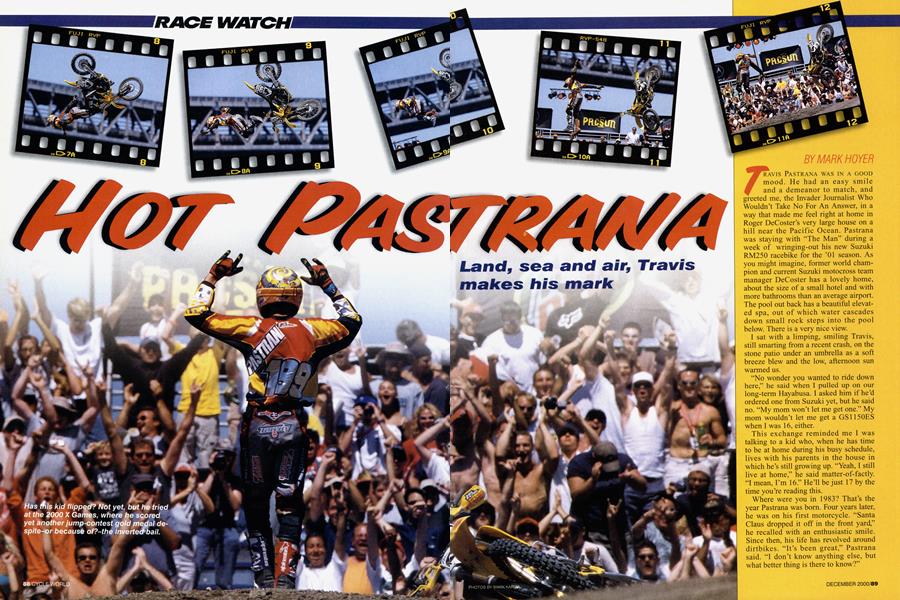
The dislocated-spine thing is slid into the conversation with a decided nonchalance. We did a small story about his injury and recovery just after his first event back-the 1999 X Games-where Pastrana scored a gold medal in the first-ever freestyle jumping event, then leapt with his motorcycle into the San Francisco Bay, firmly lodging himself in the media spotlight. But it’s worth listening to Travis tell the broken-in-half story again: “I was at a jump contest in Lake Havasu, Arizona. I think I was 15 years old at the time, and I just came up short on a 120-foot jump. Eh, no biggie, right?! If I hadn’t separated my spine and had a concussion I probably would have landed it. I just landed short, stuck and fell over. I never even hit my head, but the jolt was so bad I had a concussion, internal bleeding, multiple hip fractures and a dislocated spinal column. I was the third known case in medical history to have a dislocated spine on both—they’re called sacroiliac joints-and not be paralyzed.
I made the medical journals, which is something I guess most people don’t want to make.”
Yes, and if it weren’t for the pesky injuries, the dislocated spine, etc., he would have landed it, he said. Well, if you don’t really believe you’re going to make it, I guess you’d better not even try...
He was back on a motorcycle six months after the crash. Half the recoup time was spent in a wheelchair, the other in intense rehab. He says it’s had no effect on him physically or mentally, and that crashes are learning experiences. When he woke up in the hospital after the crash, his mom asked him, “Are you sure this is what you want to do with your life?” Travis didn’t miss a beat. “The answer has always been yes, this is worth it. It’s a great sport.”
The ability to overcome pain and return after serious injury is what sets professionals apart, said Pastrana. “Look at most of your top racers. You see some crashes that for normal people would scare them to death. But racers...before they even hit...don’t even know if they’re broken or not...they’re ready to get back on the motorcycle. In amateur racing, you have a lot of fast, talented riders who never make it; the ones who do are the ones who are not only fast, but can deal with the pain.”
His first Pro season, just this year, had its share of pain. Pastrana broke his throttle-hand thumb just a few weeks before the first 125cc East Supercross. Early results were still good, and then came the fourth 125 round at Daytona, which he won, even after a crash had knocked him silly. He ended up winning only once more during the Supercross series and finished third overall, eight points behind 125 SX champ Stephane Roncada.
Like any racer, Pastrana has his battles with confidence, and the 125cc Outdoor Motocross season had its challenges. As in Supercross, Pastrana battled injury, first torn ligaments in his wrist, then a wrecked ankle. He also battled Roncada, who was simply hauling ass, and had won six motos straight mid-season. “When you get beat over and over like I did in the middle of the season, when you get continuously beaten-and worse, passed and beaten-you start thinking, ‘Maybe he’s just better... ’ ”
The pivotal race was at Washougal, Washington. Pastrana battled with Talion Vohland for the early lead, riding with newfound speed. More importantly, though, he and Vohland pulled away from Roncada, and Pastrana took his second overall win of the season. “I figured out I just had to ride faster than I ever had in my life. From then on, I knew I was the fastest one on the track,” he said. “That carried > through and I won the last seven motos straight. I won the championship by two points.”
Certainly, Pastrana’s success on the racetrack has given him a lot of popularity, but before he proved himself on the national circuit, it was always, “Who’s this jumper kid?”
“My exposure comes definitely from the jumping,” he says. “You know what, though? Right now, I’ve only done eight jump contests in my entire life and I’ve probably done about 10,000 races. Racing is where my priorities have been.” Which makes you wonder how he got so good at jumping, for very few riders truly excel at both. “I think jumping (ability) is something that all racers have in common, but most of them take it to a certain point and say, ‘Well, this is fun, this keeps things mixed up.’ But, I want to take this to a level that no one else has done.”
That’s apparently Pastrana’s mantra: Take it to the next level. In the 2001 season, for instance, he will ride the 250cc Supercross series at least for the early rounds, and if things go well he’ll stick with it for the rest of the season, including those East Coast events at which he’ll be contesting the 125cc races, too. “The big goal in my whole life, besides winning, has been to ride 125 and 250 in the same year. I'm hoping that if I do well enough I can do both at a couple of events in 2001. Maybe the following year, ride 125s and 250s all the way through. I have to get in very, very good shape.”
The latest incredible chapter in this young man’s exploding career is his inclusion in the recent U.S. Motocross des Nations team alongside Ricky Carmichael and Ryan Hughes. Team USA won the event for the first time in four years.
“They all thought Roger (DeCoster) was crazy when he picked the team,” said Pastrana. “Except about Carmichael, who was picked to dominate by pretty much everyone. Ryan was injured, and Erna freestyle kid no one had even heard of over there on the racing circuit.”
Although Pastrana considers the MXdN a highlight in his life, the motos were tough on him-he crashed in both, explaining the limp the day I interviewed him-but rebounded, especially in the first moto, with a 10th overall and second 125. One of the hardest things, he said, was racing with 500s in the mixed-class format. “I had to go Mach 5 down the hills, then I’d pass them in the corners and they’d pass me right back,” he explained. “I was doing one jump that was about 100 feet down and maybe 120 feet distance-wise-I was the only one doing it all day. I passed a person a lap, guaranteed, on that jump. The last moto, though, I ended up crashing. I’m learning, I’m still 16.”
Pastrana will learn, and his goal of winning 250cc motocross and Supercross championships, then dominating on the world circuit seems undeniable.
All of this has made Pastrana a rider of transcendent popularity, like Jeremy McGrath, his idol with whom he is often compared. He gets requests for media interviews about twice a day, he’s been on David Letterman and the “Tonight Show” (racing through the studio with McGrath, who made sure Pastrana was invited), in men’s journals and countless motocross magazines around the world, and the Internet is thick with fans’ websites and chatrooms dedicated to the young star. Through it all, he’s been articulate, polite, creative, downto-earth, confident without being arrogant and very, very fast. He hasn’t bothered with tattoos or piercings or tantrums or an overblown ego.
No, Travis Pastrana just rides his motorcycle, which is the most powerful expression of all.