Max To the Max!
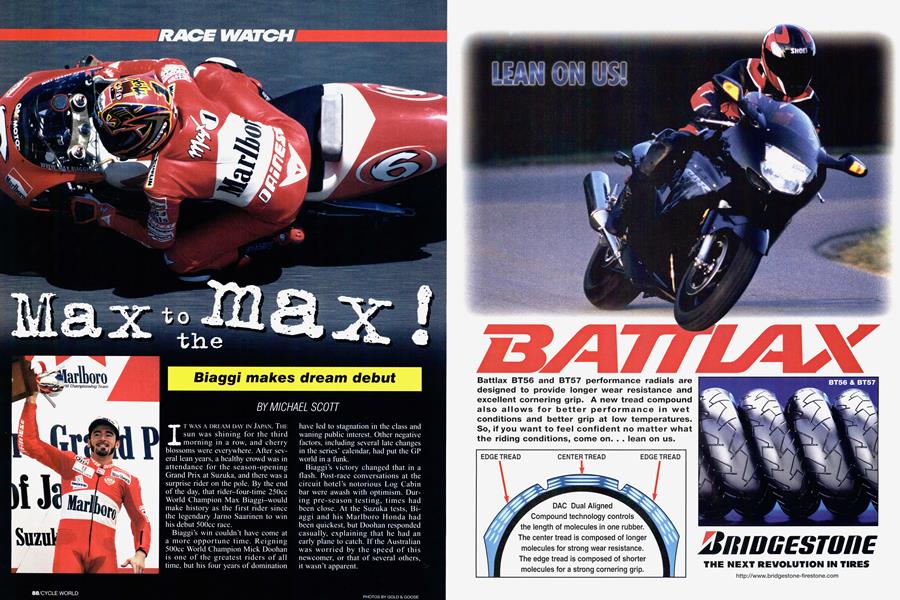
Max to the max!
RACE WATCH
Biaggi makes dream debut
MICHAEL SCOTT
IT WAS A DREAM DAY IN JAPAN. THE Sun was shining for the third morning in a row, and cherry blossoms were everywhere. After several lean years, a healthy crowd was in attendance for the season-opening Grand Prix at Suzuka, and there was a surprise rider on the pole. By the end of the day, that rider-four-time 250cc World Champion Max Biaggi-would make history as the first rider since the legendary Jarno Saarinen to win his debut 500cc race.
Biaggi's win couldn't have come at a more opportune time. Reigning 500cc World Champion Mick Doohan is one of the greatest riders of all time, but his four years of domination have led to stagnation in the class and waning public interest. Other negative factors, including several late changes in the series' calendar, had put the (IP world in a funk.
Biaggi's victory changed that in a flash. Post-race conversations at the circuit hotel's notorious Log Cabin bar were awash with optimism. Dur ing pre-season testing. times had been close. At the Suzuka tests, Bi aggi and his Marlboro Honda had been quickest, but Doohan responded casually, explaining that he had an early plane to catch. If the Australian was worried by the speed of this newcomer, or that of several others, it wasn't apparent.
This year, both Yamaha and Suzuki have revised machines. Each repre sents substantial redesign, but in dif ferent directions. Suzuki has switched from fabricated chassis construction to an extruded-tube design. Yamaha did the opposite, going from extrusion to fabrication. The goal, though, was the same: increased chassis flexibility, but in a controlled manner. This, after years of seeking ultimate stiffness only to discover that it didn't work. Both Yamaha and Suzuki riders reported an immediate improvement in "feel."
After last year's downsizing, Suzuki made only minor changes to its en gine. Yamaha, however, reworked its V-Four extensively. Besides the usual work to induction and exhaust, it changed cylinder angle and reduced internal friction. Only Yamaha report ed an increase in performance, in spite of a mandated change to unlead ed fuel that has resulted in significant power losses. If true, that reflects poorly on last year's engine. In test ing, both bikes' lap times compared favorably with those of the Honda, which is nearly identical to last year's machine. Yamaha seems to have made larger gains, but perhaps this is through strength in numbers-five bikes versus two. Nonetheless, at Suzuka, the Suzukis were within 2 mph of the fastest Honda.
The improvements translated to spots on the first two rows of the grid. Yamaha regular and `96 racewinner Norifumi Abe was seventh fastest, but wildcards Noriyuki Haga (hot off a win at the opening round of the World Superbike series) and veteran factory tester Kyoji Namba (who hadn't raced for two years and was a stand-in for the injured Jean Michel Bayle) put their YZRs on the front row of the grid, pushing Doohan to the far end. Suzuki's new boy Nobuatsu Aoki was eighth quickest, but times were as close as could be, with the top 11 inside the track record, and the top 12 inside last year's pole. So much for unlead ed fuel slowing the bikes down...
HOW did Biaggi win the race? With a typically brilliant ride, just as he had done many times in the 250cc class. Choosing a very soft tire (the Yamaha would have chewed it to pieces), he made a strong start, took the lead early and broke the opposi tion by pulling away steadily. A truly magnificent performance, let alone a rookie ride. The debut of a giant.
There was some luck involved, of course. Suzuka is an unusual circuit, blissfully flowing and fast, with a lengthy lap that favors a rider who can get into a rhythm and maintain his momentum. As Doohan had said, "It's the sort of track that suits an ex-250cc rider." But the mark of a champion is to make use of your strengths, and Bi aggi did that brilliantly, using break away tactics reminiscent of Freddie Spencer and Wayne Rainey. He did get a bit of help from the bad luck that afflicted Doohan, but in racing, you make your own luck.
Doohan has complained that the new no-lead bikes, while easier to ride because you can give them a handful of throttle without triggering instant wheelspin, are more dangerous. He has reasoned that there is much more momentum built up when the wheel does begin to spin, plus you already have the throttle wide-open. The crisp and instant partial-throttle response that gave Doohan such an advantage in the past is gone.
The change also means that the bikes burn more fuel. In the race, > Doohan's NSR carried its heaviestever fuel load. On the second lap, he braked for Turn 1 and the fork bot tomed, causing him to run off the track. It's a tribute to his skill that he didn't crash, but why didn't he prac tice with a full load of fuel so that he would know heavier springs would be necessary? In any case, any hope of Doohan winning the race was gone. He re-entered the track in 17th place and began to pick his way through the backmarkers. He was 11th when a broken crankshaft sidelined him. It was Doohan's first engine failure since 1989:
Meanwhile, the rest of the field was having plenty of fun, which promises good racing for the long season ahead. Haga was the star of the show as he threw his Dunlop-shod Yamaha about with abandon; in the end, he conceded second place to Honda's Ta dayuki Okada by the narrowest of margins. It was the 23-year-old's first GP rostrum in as many attempts.
Abe had been with this lot, but had his own comical off-track excursion, falling off at low speed then wasting time with a temper tantrum before be latedly remounting. This left Alex Criville to take fourth, some 5 sec onds adrift, with the remarkable Namba right on his back wheel.
Nobuatsu Aoki had come through to join this group, losing ground at the end when his rear tire began sliding. Nonetheless, sixth was good for the Suzuki. Then came Alex Barros, fend ing off the Movistar Honda of Carlos Checa and the Red Bull Yamaha of class rookie Simon Crafar. Spaniard Sete Gibernau was a lonely 10th in his first ride on the works V-Twin Honda originally meant for the injured Takuma Aoki.
What about John Kocinski? The reigning World Superbike Champion had an extraordinary race, receiving not one, but two stop-and-go penalties for jumping the start, then speeding in pit lane. He soldiered on to take 13th, behind Kenny Roberts Jr. on the Mod enas Triple and Doriano Romboni on the MZ Four. Kocinski did manage to hold off Abe across the line.
Ex-125cc GP star Garry McCoy made an impact on his V-Twin Shell Advance Honda. "I rode the first lap like you have to in the 125cc class," he related, "and it seemed like the others were on the warm-up lap. I was passing loads of people. I was going by Kocins ki into the hairpin when Aoki's Suzuki came right across my front wheel." The collision broke Aoki's seat, painted tire marks right up his leathers and elimi nated not only McCoy, but American privateer Matt Wait as well. New Mod enas recruit Ralf Waldmann also crashed on the first lap.
The results of this epic opening round pose several questions: Does Doohan possess the motivation to come back fighting? Does the Yama ha/Suzuki rivalry have depth? What about Kocinski? Then, there's Biaggi, who fairly and squarely scotched the accepted wisdom that it takes a 250cc rider a year or more to get the best out of a 500. After the race, the Italian gave a typically enigmatic and arro gant comment: "I am riding the bike differently from my 250, but I don't want to say more. I don't want to make it too easy for the others." Will he get his comé-uppance at the more technical tracks?
The biggest conundrum came from the fuel switch: Why were the bikes faster rather than slower? Merely say ing the bikes are easier to ride is not enough. Lap records were slashed in all three GP classes. Many top riders agreed the loss of lead may have soft ened the power a bit, but it hasn't tamed the bikes. "The power is less, so you have to open the throttle more in the corners," said Criville. "And the power doesn't come in so smoothly. I think it makes the bike harder to ride."
There was another no-lead concern in Japan: seizures. The Aprilias were particularly affected, as were several privateer Flonda V-Twins. And then there was Doohan's nearly unprece dented crank failure. Could these seizures and breakages be related to the loss of lead's lubricating effect? Yes, say some senior engineers. At the very least, they will have to cut the service life for crucial components.
Finally, what are the prospects of Kenny Roberts' Modenas project? The Malaysian-owned, three-cylin der machine is still living on promis es. The chassis has been improved, but a new engine remains on the horizon. At Suzuka, Roberts had some fancy bodywork made by car-maker Lotus. This comprised a rounded fairing and a bulbous seat, making the little bike look a bit like an Eve! Knievel stunt-jumper. It didn't last long, however, and was put away because of secondary aero dynamic effects. "It's part of an on going program," said Team Manager Chuck Aksland. Roberts wanted to say that the reshaped panels added 10 mph to the bike's top speed, but through the speed traps, the bike was only 4 mph faster.
Bottom line? After years of com placency, the 500cc class looks to be a compelling hotbed of competitionand not a second too soon. GP racing is at the forefront again. It will be in teresting to see if Doohan can rekin dle the motivation that made him a leading force in roadracing, or if he will continue to be plagued with "bad luck." Already, the 33-year-old has wondered aloud if he's too old for these shenanigans. Biaggi may have the answer.