Kawasaki Zrx1100
KAWASAKI ZRX1100
Quick Ride
The legend lives
REMEMBER Lawson Replica KAWASAKI’S KZ1000R, the limited-edition super-standard produced in homage to Steady Eddie’s pair of U.S. Superbike Championships? So, apparently, does Kawasaki. The company’s new ZRX1100 pays more than a passing resemblance to that early-’80s model, as well as to the Z1-R that preceded it.
Not just another retro-standard, the ZRX1100 instead is intended as a high-performance sportbike built with rider comfort in mind. According to Kawasaki’s engineers, their goal was to create a bike that combined the handling of a 400 with the riding position of a 750 and the engine performance of a literbike, thus guaranteeing the ZRX superiority over its competition-namely, the Honda CB1000, Suzuki Bandit 1200 and Yamaha XJR1200.
The engineers succeeded, as I found out when I had an opportunity to ride the bike in and around Tokyo, Japan. The ZRX’s liquid-cooled, dohc, inline-Four is based on that of the 1995 GPzl 100, which itself was based on the omnipotent ZX11-the main difference is the former’s sidedraft (rather than downdraft) cylinder head. Chief changes to the ZRX engine include new camshafts, pistons and a five-speed (down from six-speed) transmission. Displacement remains at 1052cc, with output limited to 100 horsepower at 8500 rpm for the
Japanese domestic market. That figure is a bit misleading, however, as the ZRX is stronger than a ZX-11 below 7000 rpm; above that mark, however, the latter derives additional boost from its ram-air induction system.
The ZRX’s steel double-cradle frame is all-new, with an
aluminum right-side downtube that unbolts to ease major engine servicing and a bridged aluminum swingarm with eccentric axle adjusters to facilitate chain tensioning. Front brakes are the same superb Tokico six-piston jobs employed on the ZX-7R racer-replica.
My first impression of the ZRX was one of power; a quick snap of the throttle in first gear brought the front wheel right up! Beyond that, the 488-pound machine’s nimble handling, sport-biased suspension and abundant cornering clearance impressed me most. The ZRX is much more exciting than its predecessor, the ZR1100 Zephyr, and has little trouble leaving the heavier ZX11 behind on twisty backroads.
Shortcomings are few. Although the engine is smooth at legal freeway speeds, in Japan, as in America, most riders ignore posted recommendations. Cruising at real-world speeds therefore makes the engine feel a bit restless. A smaller rear sprocket would help tame the vibration, but also would reduce acceleration.
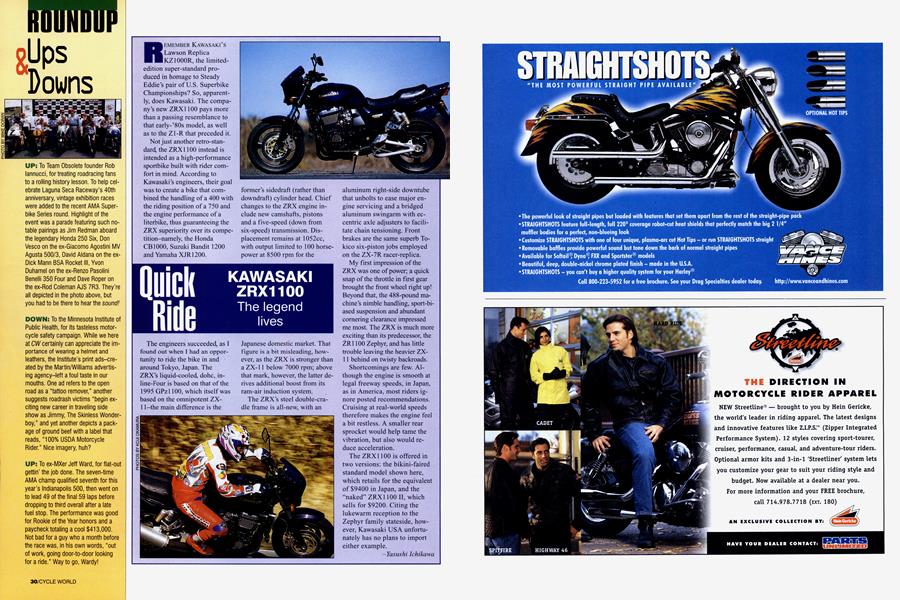
The ZRX1100 is offered in two versions: the bikini-faired standard model shown here, which retails for the equivalent of $9400 in Japan, and the “naked” ZRX 1100 II, which sells for $9200. Citing the lukewarm reception to the Zephyr family stateside, however, Kawasaki USA unfortunately has no plans to import either example.
Yasushi Ichikawa