Six Days In the Life of An Rmx
SIX DAYS IN THE LIFE OF AN RMX
RACE WATCH
The care and feeding of your best friend during the ISDE
THE THREE UGLIEST LETters in the alphabet are D, N and F. Or at least a “Did Not Finish" entry in the column next to my name on the ISDE roster would be the ugliest sight I had ever seen. I didn't travel all over the U.S. to qualify for the Six-Days, spending an unthinkable amount of my savings in the process, to get to Germany and have my dreams fall into pieces along with my motorcycle. The bike would have to be set up right before it left the U.S.
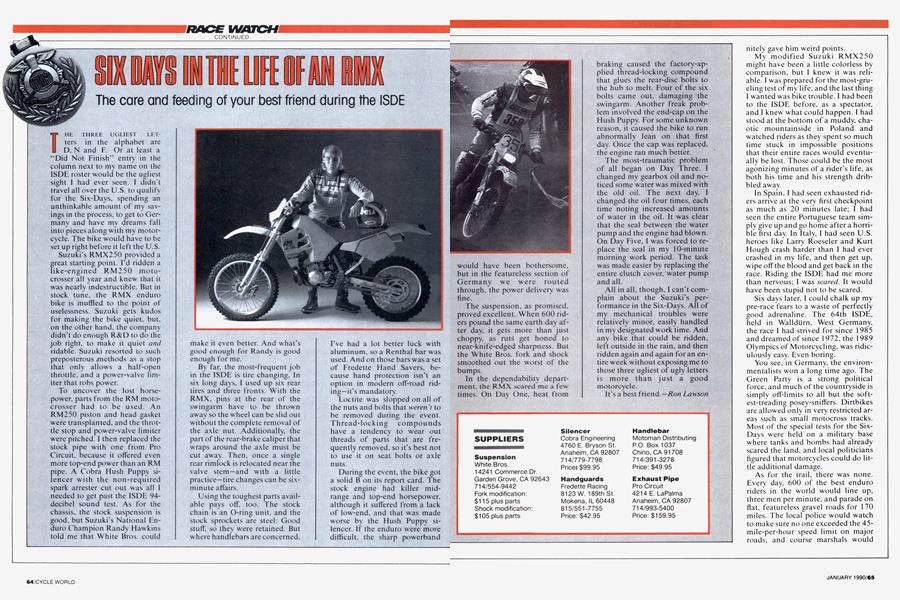
Suzuki's RMX250 provided a great starting point. I'd ridden a like-engined RM250 motocrosser all year and knew that it was nearly indestructible. But in stock tune, the RMX enduro bike is muffled to the point of uselessness. Suzuki gets kudos for making the bike quiet, but. on the other hand, the company didn’t do enough R&D to do the job right, to make it quiet and ridable. Suzuki resorted to such preposterous methods as a stop that only allows a half-open throttle, and a power-valve limiter that robs power.
To uncover the lost horsepower, parts from the RM motocrosser had to be used. An RM250 piston and head gasket were transplanted, and the throttle stop and power-valve limiter were pitched. I then replaced the stock pipe with one from Pro Circuit, because it offered even more top-end power than an RM pipe. A Cobra Hush Puppy silencer with the non-required spark arrester cut out was all I needed to get past the ISDE 94decibel sound test. As for the chassis, the stock suspension is good, but Suzuki's National Enduro Champion Randy Hawkins told me that White Bros, could make it even better. And what's good enough for Randy is good enough for me.
By far. the most-frequent job in the ISDE is tire changing. In six long days, I used up six rear tires and three fronts. With the RMX. pins at the rear of the swingarm have to be thrown away so the wheel can be slid out without the complete removal of the axle nut. Additionally, the part of the rear-brake caliper that wraps around the axle must be cut away. Then, once a single rear rimlock is relocated near the valve stem—and with a little practice—tire changes can be sixminute affairs.
Using the toughest parts available pays off. too. The stock chain is an O-ring unit, and the stock sprockets are steel: Good stuff, so they were retained. But w here handlebars are concerned.
I've had a lot better luck with aluminum, so a Renthal bar was used. And on those bars was a set of Fredette Hand Savers, because hand protection isn’t an option in modern off-road riding—it's mandatory.
Loctite was slopped on all of the nuts and bolts that weren't to be removed during the event. Thread-locking compounds have a tendency to wear out threads of parts that are frequently removed, so it’s best not to use it on seat bolts or axle nuts.
During the event, the bike got a solid B on its report card. The stock engine had killer midrange and top-end horsepower, although it suffered from a lack of low-end, and that was made worse by the Hush Puppy silencer. If the enduro wrere more difficult, the sharp powerband would have been bothersome, but in the featureless section of Germany we were routed through, the power delivery was fine.
The suspension, as promised, proved excellent. When 600 riders pound the same earth day after day, it gets more than just choppy, as ruts get honed to near-knife-edged sharpness. But the White Bros, fork and shock smoothed out the worst of the bumps.
In the dependability department, the RMX scared me a few times. On Day One. heat from braking caused the factory-applied thread-locking compound that glues the rear-disc bolts to the hub to melt. Four of the six bolts came out, damaging the swingarm. Another freak problem involved the end-cap on the Hush Puppy. For some unknown reason, it caused the bike to run abnormally lean on that first day. Once the cap was replaced, the engine ran much better.
The most-traumatic problem of all began on Day Three. I changed my gearbox oil and noticed some water was mixed with the old oil. The next day, I changed the oil four times, each time noting increased amounts of water in the oil. It was clear that the seal between the water pump and the engine had blown. On Day Five, I was forced to replace the seal in my 10-minute morning work period. The task was made easier by replacing the entire clutch cover, water pump and all.
All in all, though. I can't complain about the Suzuki’s performance in the Six-Days. All of my mechanical troubles were relatively minor, easily handled in my designated work time. And any bike that could be ridden, left outside in the rain, and then ridden again and again for an entire week without exposing me to those three ugliest of ugly letters is more than just a good motorcycle. It's abest friend.
Ron Lawson
nitely gave him weird points.
My modified Suzuki RMX250 might have been a little colorless by comparison, but I knew it was reliable. I was prepared for the most-grueling test of my life, and the last thing I wanted was bike trouble. I had been to the ISDE before, as a spectator, and I knew what could happen. I had stood at the bottom of a muddy, chaotic mountainside in Poland and watched riders as they spent so much time stuck in impossible positions that their entire races would eventually be lost. Those could be the most agonizing minutes of a rider’s life, as both his time and his strength dribbled away.
In Spain, I had seen exhausted riders arrive at the very first checkpoint as much as 20 minutes late; I had seen the entire Portuguese team simply give up and go home after a horrible first day. In Italy, I had seen U.S. heroes like Larry Roeseler and Kurt Hough crash harder than I had ever crashed in my life, and then get up, wipe off the blood and get back in the race. Riding the ISDE had me more than nervous; I was scared. It would have been stupid not to be scared.
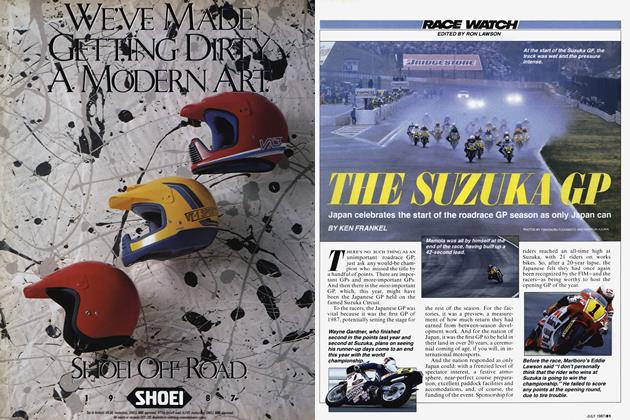
Six days later, I could chalk up my pre-race fears to a waste of perfectly good adrenaline. The 64th ISDE, held in Walldürn, West Germany, the race I had strived for since 1985 and dreamed of since 1972, the 1989 Olympics of Motorcycling, was ridiculously easy. Even boring.
You see, in Germany, the environmentalists won a long time ago. The Green Party is a strong political force, and much of the countryside is simply off-limits to all but the softest-treading posey-sniffers. Dirtbikes are allowed only in very restricted areas such as small motocross tracks. Most of the special tests for the SixDays were held on a military base where tanks and bombs had already scared the land, and local politicians figured that motorcycles could do little additional damage.
As for the trail, there was none. Every day, 600 of the best enduro riders in the world would line up, three men per minute, and parade on flat, featureless gravel roads for 170 miles. The local police would watch to make sure no one exceeded the 45mile-per-hour speed limit on major roads, and course marshals would take down the number of any rider who overshot a turn and ventured into a farmer's field by so much as a foot. I envisioned the ISDE as being a test of courage, stamina and strength. Instead this one was merely a test of patience. Every day I would do my time on the two-track roads—usuallv
just boundary roads between farm plots—and eagerly look forward to the special tests.
In international-rule enduros, like the Six-Days and the qualifiers, riders are scored on two levels. Trail points are received if a rider arrives late at any checkpoint. These weren't a factor in Germany because riders were arriving at checks from six to 20 minutes early and then waiting for their time to pass through. So, the entire event was decided by special-test points, which are simply the number of seconds it takes each rider to race through a given course. These are accumulated through six days of riding, with the lowest score w inning.
According to modern ISDE rules, in order to earn a gold medal, a rider's score can be no more than 10 percent greater than the class winner's. I quickly discovered that if everything went perfectly for me in a given special test, I was still about 12 percent slower than the fastest rider. That meant I had no chance of getting a gold medal: the best I could hope for was silver. So, not only was the terrain a disappointment, so was my own riding ability.
Not that the event didn’t present challenge. When you ride a dirtbike for seven hours a day, six days in a row', just keeping all the parts bolted together is difficult. Each night the motorcycles were kept in an impound area where they couldn't be w'orked on. All repairs or adjustments had to be made during 10-minute work periods each morning and night. So, even the slightest mechanical problem could be a major obstacle.
The biggest challenge for me, though, was not getting disqualified for six straight days. On Day One, officials wanted to disqualify me for changing carburetor jetting in an area that was reserved for refueling only. I
SUPPLIER
Engine modifications, suspension components, tires
White Bros. 14241 Commerce Drive Garden Grove, CA 92643 714/554-9442