The Racer's Code
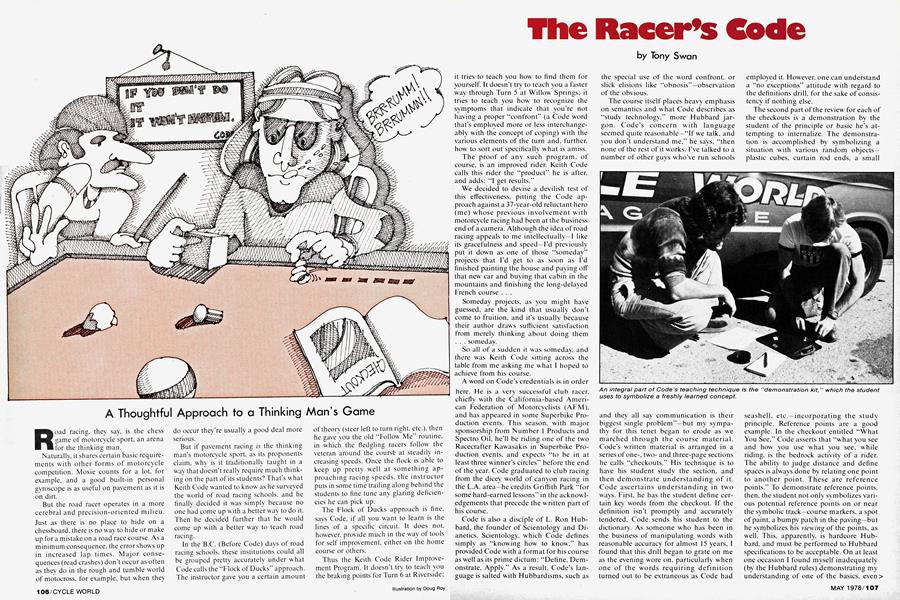
A Thoughtful Approach to a Thinking Man’s Game
Road racing. they say, is the chess game of motorcycle sport, an arena for the thinking man.
Naturally, it shares certain basic requirements with other forms of motorcycle competition. Moxie counts for a lot, for example, and a good built-in personal gyroscope is as useful on pavement as it is on dirt.
But the road racer operates in a more cerebral and precision-oriented milieu.
Just as there is no place to hide on a chessboard, there is no way to hide or make up for a mistake on a road race course. As a minimum consequence, the error shows up in increased lap times. Major consequences (read crashes) don’t occur as oiten as they do in the rough and tumble world of motocross, for example, but when they do occur they're usually a good deal more serious.
But if pavement racing is the thinking man’s motorcycle sport, as its proponents claim, why is it traditionally taught in a way that doesn’t really require much thinking on the part of its students? That's what Keith Code wanted to know as he surveyed the world of road racing schools, and he finally decided it was simply because no one had come up with a better way to do it. Then he decided further that he would come up with a better way to teach road racing.
In the B.C. (Before Code) days of road racing schools, these institutions could all be grouped pretty accurately under what Code calls the “Flock of Ducks” approach. The instructor gave you a certain amount of theory (steer left to turn right, etc.), then he gave you the old “Follow Me ’ routine, in which the fledgling racers follow the veteran around the coursé at steadily increasing speeds. Once the flock is able to keep up pretty well at something approaching racing speeds, the instructor puts in some time trailing along behind the students to fine tune any glaring deficiencies he can pick up.
The Flock of Ducks approach is fine, says Code, if all you want to learn is the lines of a specific circuit. It does not, however, provide much in the way of tools for self improvement, either on the home course or others.
Thus the Keith Code Rider Improvement Program. It doesn’t try to teach you the braking points'for Turn 6 at Riverside; it tries to teach you how to find them for yourself. It doesn't try to teach you a faster way through Turn 5 at Willow7 Springs; it tries to teach you how7 to recognize the symptoms that indicate that you’re not having a proper “confront” (a Code word that’s employed more or less interchangeably with the concept of coping) with the various elements of the turn and, further, how to sort out specifically what is amiss.
The Racer’s Code
Tony Swan
The proof of any such program, of course, is an improved rider. Keith Code calls this rider the “product” he is after, and adds: “I get results.”
We decided to devise a devilish test of this effectiveness, pitting the Code approach against a 37-year-old reluctant hero (me) whose previous involvement with motorcycle racing had been at the business end of a camera. Although the idea of road racing appeals to me intellectually—I like its gracefulness and speed—I’d previously put it down as one of those “someday” projects that I’d get to as soon as I'd finished painting the house and paying off that new car and buying that cabin in the mountains and finishing the long-delayed French course . . .
Someday projects, as you might have guessed, are the kind that usually don’t come to fruition, and it’s usually because their author draws sufficient satisfaction from merely thinking about doing them . . . someday.
So all of a sudden it was someday, and there was Keith Code sitting across the table from me asking me what I hoped to achieve from his course.
A word on Code’s credentials is in order
here. He is a very successful club racer, chiefly with the California-based American Federation of Motorcyclists (AFM), and has appeared in some Superbike Production events. This season, with major sponsorship from Number 1 Products and Spectro Oil, he’ll be riding one of the two Racecrafter Kawasakis in Superbike Production events, and expects “to be in at least three winner’s circles” before the end of the year. Code graduated to club racing from the dicey world of canyon racing in the L.A. area—he credits Griffith Park “for some hard-earned lessons” in the acknowledgements that precede the written part of his course.
Code is also a disciple of L. Ron Hubbard, the founder of Scientology and Dianetics. Scientology, which Code defines simply as “knowing how to know,” has provided Code with a format for his course as well as its prime dictum: “Define, Demonstrate, Apply.” As a result. Code’s language is salted with Hubbardisms, such as
the special use of the word confront, or slick elisions like “obnosis”—observation of the obvious.
The course itself places heavy emphasis on semantics and what Code describes as “study technology,” more Hubbard jargon. Code’s concern with language seemed quite reasonable—“If we talk, and you don’t understand me,” he says, “then none of the rest of it works. I’ve talked to a number of other guys who’ve run schools and they all say communication is their biggest single problem”—but my sympathy for this tenet began to erode as we marched through the course material. Code’s written material is arranged in a series of one-, twoand three-page sections he calls “checkouts.” His technique is to have his student study the section, and then demonstrate understanding of it. Code ascertains understanding in two ways. First, he has the student define certain key words from the checkout. If the definition isn’t promptly and accurately tendered. Code sends his student to the dictionary. As someone who has been in the business of manipulating words with reasonable accuracy for almost 15 years, I found that this drill began to grate on me as the evening wore on, particularly when one of the words requiring definition turned out to be extraneous as Code had employed it. However, one can understand a “no exceptions” attitude with regard to the definitions drill, for the sake of consistency if nothing else. seashell, etc. —incorporating the study principle. Reference points are a good example. In the checkout entitled “What You See,” Code asserts that “what you see and how you use what you see, while riding, is the bedrock activity of a rider. The ability to judge distance and define spaces is always done by relating one point to another point. These are reference points.” To demonstrate reference points, then, the student not only symbolizes various potential reference points on or near the symbolic track—course markers, a spot of paint, a bumpy patch in the paving—but he symbolizes his viewing of the points, as well. This, apparently, is hardcore Hubbard, and must be performed to Hubbard specifications to be acceptable. On at least one occasion I found myself inadequately (by the Hubbard rules) demonstrating my understanding of one of the basics, even> though 1 understood it well enough. That particular demonstration was particularly annoying, and others, more successful, cloyed on me when they didn't actually irritate.
The second part of the review for each of the checkouts is a demonstration by the student of the principle or basic he’s attempting to internalize. The demonstration is accomplished by symbolizing a situation with various random objects— plastic cubes, curtain rod ends, a small
However, Code is adamant about his procedures and will cheerfully refund a student’s fee ($50 for the Basic Rider’s Course, $175 for the complete Rider Improvement Program) rather than proceed on a basis of imperfect or suspect understanding.
“If you can’t demonstrate it to me.” he says, “as far as I’m concerned you can't do it.”
Covering the 14 pieces of printed material that constitute the classroom part of the course takes the better part of a day. Code invariably conducts this procedure
one-on-one, although he w ill usually try to assemble two or three riders at the race course (Willow Springs Raceway, near Lancaster, about 80 miles north of Los Angeles) for the track portion of the course. His feeling about handling only one student at a time is that it's the only way he can be certain he's making his points; it’s an attitude that keeps him from publishing his material as a correspondence course, since he can't be sure it will be properly digested.
The material is very positive in nature. For example, in a checkout identifying barriers to improvement. Code states that “ . . . barriers ... are the stepping stones to your objective—going fast." Barriers shouldn't be regarded as barriers at all; they should be regarded as opportunities. Similarly, Code refuses to talk about the traditional “don't-do's”, because they're negative.
All of a sudden it was “someday” and there was Keith Code asking me what I hoped to achieve from his course
“In order to not do something,” he says, “you first have to get into a situation where the don't-do applies, then not do it."
He also discounts most of the negative experiences a rider might accumulate. For example: “Falling down doesn’t help you at all: it only teaches you what won't
work.”
About the only don’t-do Code employs is this one: “If you don't do it, it won’t happen."
After I'd internalized the bulk of Code's written material pretty much to his nearsatisfaction. we were ready to see what my new learning ability would do to lap times at Willow Springs. Besides a few pit lane drills—simultaneous downshifting and front braking, practicing with the front brake at low' speeds, etc.—I set out to learn the course, applying a check list that Code uses every time he sets out to ride a race course. It entails seven steps, to wit:
“I’m not teaching anyone to ride like me; but with the basics I’ve isolated here you’ll be able to ride like you, and know you can get better”
1. Notice there is a track (look at it).
2. Discover how many turns or changes there are in the track and number them for yourself. Identify each turn or change—a left, a right, a series such as esses, etc.
3. Qualify each turn as to its individual characteristics, such as a hard right, a decreasing radius sweeper, a downhill left, etc.
4. Decide on a tentative product (meaning an exit point embodying optimum speed through the turn and optimum drive out of it).
5. Pick out and record from memory the points, objects, landmarks, etc., which you use to gauge when to brake, accelerate, turn. etc.
6. Go out and find other points of reference in a particular turn you have your attention on.
7. Repeat #6 for each turn or section until you are comfortable with them.
Our long-term Kawasaki KZ650, equipped with Dunlop K81s at both ends, made a rather hairy but familiar school mount, and I went out and soldiered around until I felt I had the layout of the place in hand while Code manned the stopwatches.
When I got back, he checked the tires, with particular attention to the front.
which was brand new. The check didn't take long.
“They're not really very warm yet.” he said, keeping his face as straight as possible.
They should be warm. 1 thought. I've been all over the bloody course, a new7 rider phenomenon Code calls “learning by ricochet.” There didn’t seem to be much to say, so 1 went over the course again slowly to pick up additional reference points, then circulated faster for a few more laps before we broke for lunch. By that time 1 w7as getting through Willow's 2.5-mile, nine-turn uphill-downhill layout in about 2:05, a 72-mph average.
When I came in. Code began in earnest.
“OK. what’s going on out there in Turn 8?” he asked.
“Well, I'm probably getting into it a little too slow.” I said. This seemed safe; I felt I was getting into all the turns too slowly and 8, a sweeping right-hander off the back straight, is one of the fastest turns on the course.
“Do you have a product in mind for the turn?” he asked.
I muttered something about wanting to emerge somewhere near that big orange cone that more or less marks the beginning stages of Turn 9.
“What are you doing with the throttle?”
“Well. I'm sorta rolling off about the time I sit up out of my tuck.”
“Here’s something to think about. You don’t make up time in slow7 turns. You make up time in fast ones. What can you do to make up time in that turn?”
Code is releniess. He won't teil you what to do~ he'll tell you now to figure it out For yourself
There was a great deal of this grilling during lunch and throughout the afternoon. Code is relentless. He won’t tell you what to do if he can avoid it; he’ll tell you how to figure out how to do it for yourself.
Does it work? The course doesn’t stop with the one-day session at Willow7. Code also includes observations at six local club races in his package. But for the purposes of our report, which has to be at the printer
before I’ll have a chance to apply Code’s codes in actual competition, I’d have to say yes, it does.
Even working with an uncertain quantity such as myself. Code was able to help me get my times down to fairly respectable 1:58s. The best lap of the day was 1:56.6 (77.2 mph), but I wasn't able to duplicate it and wasn't quite sure how I'd done it.
Just as the e is no piace In hide on a c~ sst)oard~ t'ieii~ is no way to make up for or jude a mistake on a `nac r~ ce ourse
Code handled this without ever going out onto the track himself. He managed it without saying, “Look, dummy, use a later apex in Turn 3,” although I’m sure he must have been tempted to do so.
Absent from the Keith Code Rider Improvement Program (Code claims the initials R.I.P. are purely coincidental) is any mention of technique. I'd envisioned some drills entailing me hanging from the bike at odd angles. But Code points out, as kindly as possible, that refinements like technique come after you’ve mastered basics. He also refrains from giving you lots of trick tips.
“Some guys come to me and want to learn all the tricks, and that bugs me,” he
says.
“I'm not teaching anyone to ride like
me; but with the basics I’ve isolated here you'll be able to ride like you, and know you can get better.”
Although Willow Springs still has a couple of blank spots for me, I know7 the foregoing to be reasonably accurate, based on my own experience. And while I'm not sure that Keith Code has totally preempted the Flock of Ducks approach—for some riders, this traditional method may create a much stronger sense of security—he has certainly opened a viable new approach to self-improvement for serious pavement racers. And serious racers are the only ones he’s really interested in.
For further information on the Code program, contact Keith at 6416 Fa Mirada Ave., Eos Angeles, Calif. 90038.