Round·up
ROUND·UP
DEPARTMENTS
JOE PARKHURST
ALTHOUGH there is a
formal reply from the American Motorcycle Association coming, I thought it might be prudent if I made mention of the rule passed by the AMA board of trustees— of which I am one—that we editorially attacked in CYCLE WORLD (Jan. ‘76).
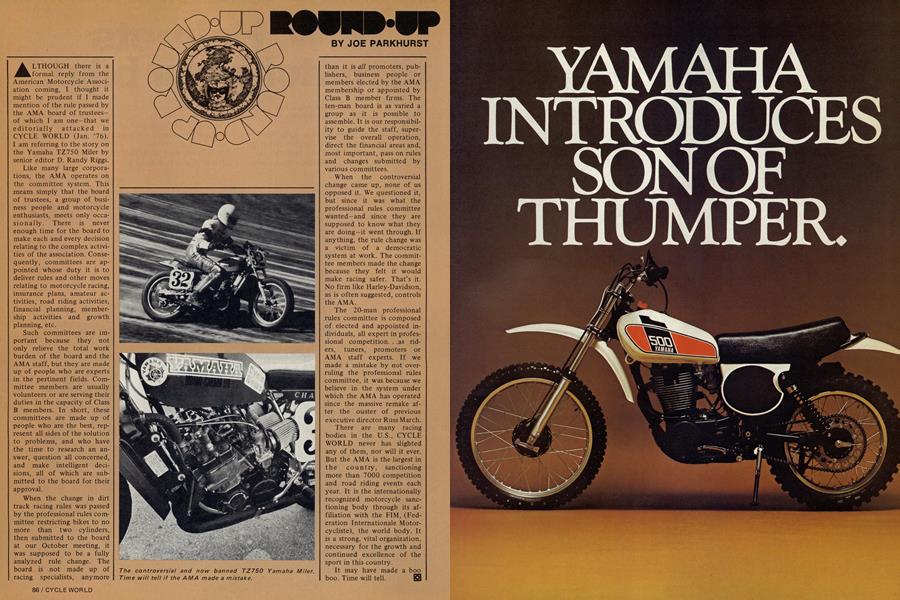
I am referring to the story on the Yamaha TZ750 Miler by senior editor D. Randy Riggs.
Like many large corporations, the AMA operates on the committee system. This means simply that the board of trustees, a group of business people and motorcycle enthusiasts, meets only occasionally. There is never enough time for the board to make each and every decision relating to the complex activities of the association. Consequently, committees are appointed whose duty it is to deliver rules and other moves relating to motorcycle racing, insurance plans, amateur activities, road riding activities, financial planning, membership activities and growth planning, etc.
Such committees are important because they not only relieve the total work burden of the board and the AMA staff, but they are made up of people who are experts in the pertinent fields. Committee members are usually volunteers or are serving their duties in the capacity of Class B members. In short, these committees are made up of people who are the best, represent all sides of the solution to problems, and who have the time to research an answer, question all concerned, and make intelligent decisions, all of which are submitted to the board for their approval.
When the change in dirt track racing rules was passed by the professional rules committee restricting bikes to no more than two cylinders, then submitted to the board at our October meeting, it was supposed to be a fully analyzed rule change. The board is not made up of racing specialists, anymore than it is all promoters, publishers, business people or members elected by the AMA membership or appointed by Class B member firms. The ten-man board is as varied a group as it is possible to assemble. It is our responsibility to guide the staff, supervise the overall operation, direct the financial areas and, most important, pass on rules and changes submitted by various committees.
When the controversial change came up, none of us opposed it. We questioned it, but since it was what the professional rules committee wanted—and since they are supposed to know what they are doing—it went through. If anything, the rule change was a victim of a democratic system at work. The committee members made the change because they felt it would make racing safer. That’s it. No firm like Harley-Davidson, as is often suggested, controls the AMA.
The 20-man professional rules committee is composed of elected and appointed individuals, all expert in professional competition. . .as riders, tuners, promoters or AMA staff experts. If we made a mistake by not overruling the professional rules committee, it was because we believe in the system under which the AMA has operated since the massive remake after the ouster of previous executive director Russ March.
There are many racing bodies in the U.S., CYCLE WORLD never has slighted any of them, nor will it ever. But the AMA is the largest in the country, sanctioning more than 7000 competition and road riding events each year. It is the internationally recognized motorcycle sanctioning body through its affiliation with the FIM, (Federation Internationale Motorcycliste), the world body. It is a strong, vital organization, necessary for the growth and continued excellence of the sport in this country.
It may have made a boo boo. Time will tell.