Husqvarna 360cr
HUSQVARNA 360CR
Cycle World Road Test
Is anybody out there ready for an honest 39 horsepower?
■ IT SEEMS SOMEWHAT puzzling that a motorcycle manufacturer—any of whom could use a big-selling model in this time of diminishing sales and rising prices— would produce a machine that they know in advance is designed for a smaller segment of the market than its predecessor. Yet Husqvarna has done so. And as proud as they should be of the machine, their tactics are confusing at best. But road tests are not the best places to analyze marketing practices.
This is where you find out about machinery, both good and bad. Husqvarna’s 354cc Heikki Mikkola Replica abounds in the former, with an occasional touch of the latter.
It was in 1973 that Heikki Mikkola had his first really good year in International motocross. He finished 3rd overall, the best placing in the 250 class for Husky since the days of Torsten Hallman and his four World Championships. In ‘74, Husky produced its first magnesium-engined motorcycle in 250cc size. It was supposed to be identical to what Mikkola rode the previous year. It was fast, it handled, and it did have a mag engine, but even though the shocks were moved forward slightly, it wasn’t really a carbon copy replica. That year, with the 250 on the market and Mikkola racing a 500 class bike, Husky captured the World Title for the first time since Roger DeCoster and his Suzukis began their domination of big-bore motocross. Nineteen seventy-four was Husky’s biggest year in a long time and this year they are really celebrating it.
If there are any differences between the Husky on these pages or on the showroom floor and the factory racer that carried Mikkola to his glory, it comes in the form of a three-pound weight difference. The FIM limit last year was 209 pounds for 500-class bikes. Of course, that’s exactly what Heikki’s racer weighed. Our test bike scaled in right at the advertised weight—212 pounds dry. Husky says that the difference comes from titanium nuts and bolts that were used on Mikkola’s bike, but not on the production units.
The 360CR is as fast as you’d expect it to be. Maybe even faster. It gets its power from a reed-valve, all-magnesium engine. Such vital stress areas as the cylinder, bearing pockets and engine-mount flanges have steel inserts for long life, but all of the castings are magnesium. Even the reed cage is cast in magnesium.
The twin pyramid reeds are four in number, covering eight reed openings and feeding the engine through a pair of vertically rectangular intake windows on the back side of the piston before going “full-on” as the piston skirt completely clears the port. From there, the fuel mixture travels through a simple pair of transfers (one on each side), to the top side of the piston. After combustion, burnt gases are routed through a bridged exhaust port. Not as complicated as one might expect, considering the radical amount of power on tap.
The quantity of power that the Husky possesses is mind-boggling. Its location, however, is hardly representative of most production big-bores. The engine is pipey. Really pipey for its size. To get it to pump so hard, some bottom end had to be sacrificed. However, the six-speed gearbox works well to keep the engine in its better range. Ratios are very close and flywheel effect is next to nothing. Try to come out of a corner in the wrong gear and the bike will let you know in no uncertain terms that you blew it. It won’t cough, sputter or load up. It’ll just die, right on the spot. You’ve got to really be on the ball when you ride this 360. No less than 100 percent concentration will do.
Shifting through the gears, one notices that the gearbox demands positive shifting. Again, sloppiness will cost you time. The long throw of the shift lever is something that all Husky riders must become accustomed to, just as they must adjust their styles to compensate for the exhaust pipe getting in their way a little. But the air filter canister on this Husky has been redesigned to eliminate interference on the right side.
Chassis-wise, the 360 has undergone some changes. The high-quality chrome moly frame remains, but the frame members that used to run up from the footpegs to the rear fender loop—where the upper shock mounts were—now are situated in a more vertical position, with a dog-leg bend several inches below the seat.
This dog-leg point is where the new upper shock mounts are. The resulting angling of the Girling gas/oil emulsion shocks yields more than seven inches of travel at the axle. As far as gas/oil shocks go, the Girlings on the Husky are unique. Most of these type shocks have the gas and oil separated from each other by a seal. The Girlings run the pressurized nitrogen mixed in with the damping oil. By keeping the air bubbles within the oil to minute sizes through a patented process, they are able to maintain damping characteristics even when gas passes through the damping valve. The result is a more reliable shock. And you can rest assured that, just like most other gas/oil shocks, they don’t fade.
Husky reports that Mikkola used a single pair of Girling dampers for five GPs and didn’t notice any fade during those ten motos. Another advantage of pressurized shocks is that you can run them in any position. They come mounted upside down straight from the Husky factory. This alleviates some of the unsprung weight at the rear.
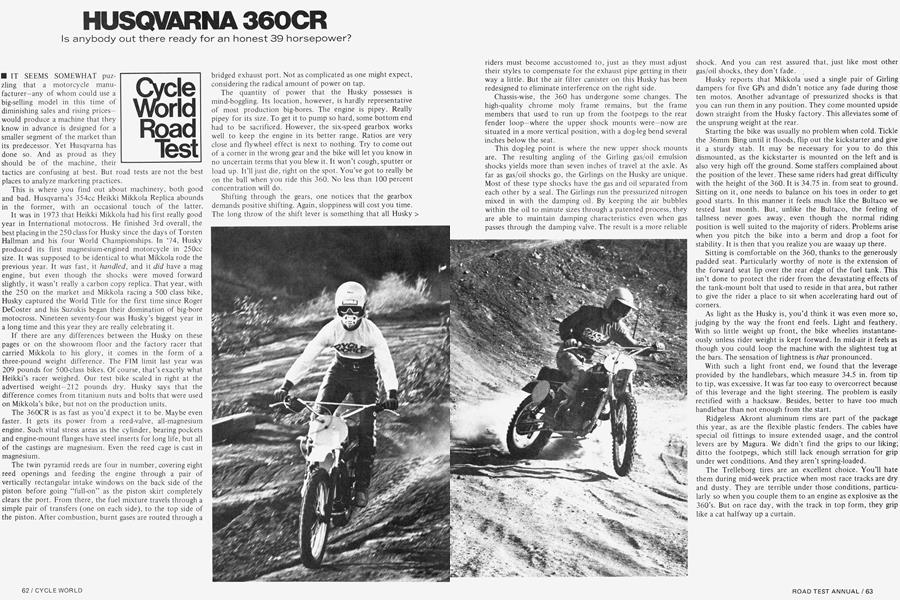
Starting the bike was usually no problem when cold. Tickle the 36mm Bing until it floods, flip out the kickstarter and give it a sturdy stab. It may be necessary for you to do this dismounted, as the kickstarter is mounted on the left and is also very high off the ground. Some staffers complained about the position of the lever. These same riders had great difficulty with the height of the 360. It is 34.75 in. from seat to ground. Sitting on it, one needs to balance on his toes in order to get good starts. In this manner it feels much like the Bultaco we tested last month. But, unlike the Bultaco, the feeling of tallness never goes away, even though the normal riding position is well suited to the majority of riders. Problems arise when you pitch the bike into a berm and drop a foot for stability. It is then that you realize you are waaay up there.
Sitting is comfortable on the 360, thanks to the generously padded seat. Particularly worthy of note is the extension of the forward seat lip over the rear edge of the fuel tank. This isn’t done to protect the rider from the devastating effects of the tank-mount bolt that used to reside in that area, but rather to give the rider a place to sit when accelerating hard out of corners.
As light as the Husky is, you’d think it was even more so, judging by the way the front end feels. Light and feathery. With so little weight up front, the bike wheelies instantaneously unless rider weight is kept forward. In mid-air it feels as though you could loop the machine with the slightest tug at the bars. The sensation of lightness is that pronounced.
With such a light front end, we found that the leverage provided by the handlebars, which measure 34.5 in. from tip to tip, was excessive. It was far too easy to overcorrect because of this leverage and the light steering. The problem is easily rectified with a hacksaw. Besides, better to have too much handlebar than not enough from the start.
Ridgeless Akront aluminum rims are part of the package this year, as are the flexible plastic fenders. The cables have special oil fittings to insure extended usage, and the control levers are by Magura. We didn’t find the grips to our liking; ditto the footpegs, which still lack enough serration for grip under wet conditions. And they aren’t spring-loaded.
The Trelleborg tires are an excellent choice. You’ll hate them during mid-week practice when most race tracks are dry and dusty. They are terrible under those conditions, particularly so when you couple them to an engine as explosive as the 360’s. But on race day, with the track in top form, they grip like a cat halfway up a curtain.
During our initial laps on the bike we were not happy with the performance of the shock absorbers. The engine was pretty new so we didn’t want to push real hard. Once we had about a half hour on it, we opened it up to see what it would do. Again the shocks didn’t measure up. But after a few more laps at racing speed, they bedded in, or so we thought. Next time out we encountered the same problem. It would take about four to five minutes of use before they began performing as expected.
The Girlings are designed to operate at a given temperature. You have to get them hot before they’ll work. As long as you don’t let them cool off competely they’re fine. On the other hand, the forks worked flawlessly after about two laps of initial stiffness.
The Husky’s really doesn’t feel like a European motor. It is far too pipey and has too little flywheel to exhibit the strong pulling characteristics usually associated with continental machinery. Instead, it zaps about with violent surges more commonly associated with Japanese buzz-bomb motors. The engine was bulletproof during our test, suffering its only failure in the shifting department. The shifter return spring broke during a WFO slide out. As further testament to the near indestructability of the engine, just look at Mikkola’s DNF record for this last GP season. Many fewer than his competitors.
Running it from its very first power stroke on Castrol R at a 25:1 ratio—as recommended by Claus Nilsson, Head Makemfast for the distributor—the bike didn’t even foul a plug during our test. Several weeks of abuse didn’t make it any harder to start either. The spark provided by the Femsa ignition is strong at all speeds. Once set, the timing shouldn’t have to be reset for a long time.
The Husky steers a little better than last year’s big bore, although it still won’t slide. Part of the reason is that the long-travel rear suspension has raised the back of the bike up and drawn the fork rake in. To compensate for this, Husky has altered the rake somewhat, but not enough. This causes the improved steering. The front end still pushes if you try to coast through a corner, so you must keep some power going to the rear wheel in order to make the front track, but it takes a judicious throttle hand to be able to feed it just enough. Riding the Husky is a constant mental battle to give it just enough. Not enough and you go nowhere; just enough and you go fast; a little too much and you go down.
DYNAMOMETER TEST HORSEPOWER AND TORQUE
HUSQVARNA 360CR
$1895
This is not the “every man’s answer” machine. It is not designed for the masses. It will, undoubtedly, end up in the hands of Upjohn Novices everywhere who will have shelled out their bucks, convinced that this is the machine that will take them from the depths of the Beginner’s Class to stardom. All it will do is entrench them deeper into their deserved niches.
There is a lot of machine here. A helluva lot. It is a machine for the thinking motocrosser; not the guy who rides on instinct and fearless fortitude, but the one who can maintain track of the proper gear, proper line, proper body position and proper amount of throttle, all while going faster than he’s ever gone before. This is a machine for the Experts’ expert. It is enough motocrosser for anyone. The question then is: Are you enough motocrosser for it? For $1895, you’d better answer that question honestly. g>