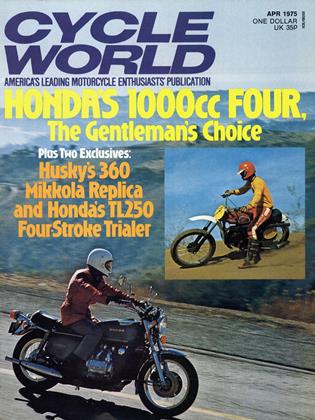
Honda Gl1000
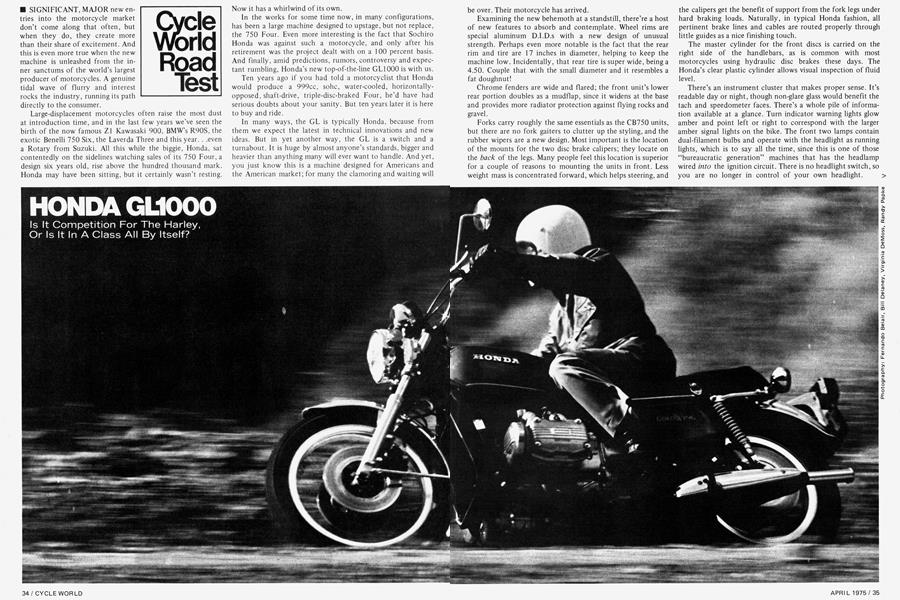
HONDA GL1000
Cycle World Road Test
Is It Competition For The Harley, Or Is It In A Class All By Itself?
SIGNIFICANT, MAJOR new entries into the motorcycle market don’t come along that often, but when they do, they create more than their share of excitement. And this is even more true when the new machine is unleashed from the inner sanctums of the world's largest producer of motorcycles. A genuine tidal wave of flurry and interest rocks the industry, running its path directly to the consumer.
Large-displacement motorcycles often raise the most dust at introduction time, and in the last few years we’ve seen the birth of the now famous Z1 Kawasaki 900, BMW’s R90S, the exotic Benelli 750 Six, the Laverda Three and this year. . .even a Rotary from Suzuki. All this while the biggie, Honda, sat contentedly on the sidelines watching sales of its 750 Four, a design six years old, rise above the hundred thousand mark. Honda may have been sitting, but it certainly wasn’t resting. Now it has a whirlwind of its own.
In the works for some time now, in many configurations, has been a large machine designed to upstage, but not replace, the 750 Four. Even more interesting is the fact that Sochiro Honda was against such a motorcycle, and only after his retirement was the project dealt with on a 100 percent basis. And finally, amid predictions, rumors, controversy and expectant rumbling, Honda’s new top-of-the-line GL1000 is with us.
Ten years ago if you had told a motorcyclist that Honda would produce a 999cc, sohc, water-cooled, horizontallyopposed, shaft-drive, triple-disc-braked Four, he’d have had serious doubts about your sanity. But ten years later it is here to buy and ride.
In many ways, the GL is typically Honda, because from them we expect the latest in technical innovations and new ideas. But in yet another way, the GL is a switch and a turnabout. It is huge by almost anyone’s standards, bigger and heavier than anything many will ever want to handle. And yet, you just know this is a machine designed for Americans and the American market; for many the clamoring and waiting will be over. Their motorcycle has arrived.
Examining the new behemoth at a standstill, there’re a host of new features to absorb and contemplate. Wheel rims are special aluminum D.I.D.s with a new design of unusual strength. Perhaps even more notable is the fact that the rear rim and tire are 17 inches in diameter, helping to keep the machine low. Incidentally, that rear tire is super wide, being a 4.50. Couple that with the small diameter and it resembles a fat doughnut!
Chrome fenders are wide and flared; the front unit’s lower rear portion doubles as a mudflap, since it widens at the base and provides more radiator protection against flying rocks and gravel.
Forks carry roughly the same essentials as the CB750 units, but there are no fork gaiters to clutter up the styling, and the rubber wipers are a new design. Most important is the location of the mounts for the two disc brake calipers; they locate on the back of the legs. Many people feel this location is superior for a couple of reasons to mounting the units in front. Less weight mass is concentrated forward, which helps steering, and the calipers get the benefit of support from the fork legs under hard braking loads. Naturally, in typical Honda fashion, all pertinent brake lines and cables are routed properly through little guides as a nice finishing touch.
The master cylinder for the front discs is carried on the right side of the handlebars, as is common with most motorcycles using hydraulic disc brakes these days. The Honda’s clear plastic cylinder allows visual inspection of fluid level.
There’s an instrument cluster that makes proper sense. It’s readable day or night, though non-glare glass would benefit the tach and speedometer faces. There’s a whole pile of information available at a glance. Turn indicator warning lights glow amber and point left or right to correspond with the larger amber signal lights on the bike. The front two lamps contain dual-filament bulbs and operate with the headlight as running lights, which is to say all the time, since this is one of those “bureaucratic generation” machines that has the headlamp wired into the ignition circuit. There is no headlight switch, so you are no longer in control of your own headlight.
Don’t get us wrong. We realize that many states have a “headlight on” law and we ride with ours on, too, though it’s not yet required in California. But when they take away the switch, it’s simply one more government control. What are they going to have our motorcycles looking like in another 10 years, in order to protect us from the culpable Detroit slaughterhogs?
Touching the horn button yields what sounds like a sufficient blast from the Honda’s horn. If this is done in an enclosed area, such as a garage, then the reverberations increase the effect of the sound. But out on the open road, the horn blast is not particularly audible by someone inside a closed auto. The horn is of little use as a warning or reprimand device. You’ll just end up filling your helmet full of well-practiced profanities. Now here is an area where legislative action could do some definite good, but legislators are too busy devising mandatory fuel petcock laws and making sure that shift patterns are stamped onto engine cases.
A nice feature of the turn indicators is a lane-change detent built into the thumb-operated switch. It’ll lock in place if you want it to stay on, but for a quickie lane change a gentle nudge does the trick. It’ll pop back into the off position by itself. By the way, those big amber blinkers go on and off with an authoritative cadence, commanding attention from the automobile drivers. Also, the instant your thumb hits the switch the lights are activated, without hesitation. With many machines there’s a slight delay of maybe a second or so before the turn signals actually light up; in that second the rider may already have completed his lane change, negating the purpose of putting on the signal. A small point, perhaps, but important nonetheless.
More warning lights? Of course. Oil pressure glows red, high beam blue, and snicking the tranny into neutral gives you a green. But there’s still more on the 1000.
Ever hear of a reserve lighting system? Neither have we, at least not on a motorcycle, but here it is. With this one “outage indication” is provided for both the headlight and taillight in the form of white (headlight) and red (taillight) warning lights near the instrument cluster. On top of that, the system will compensate for bulb failure by energizing inactive lamp filaments to substitute for the required function until repairs can be made.
What this means is that if the headlight warning light comes on, there is a problem somewhere in the headlight circuit. The low beam will shift to high beam, or vice versa, if either one burns out. But the new circuit will be operating through a resistor that will reduce the brightness at the lamp for safety purposes.
There are similar circuits in the taillight and stoplight systems. In normal operation, the red warning light will glow with front or rear brake application, letting the rider know the brakelight is working. Many machines now have this feature. But if the warning light doesn’t work when the rider hits the brakes, or if it glows continuously when the ignition switch is turned on, there’s trouble in the circuit. Once again, as with the headlight, the “outage reserve” will take over and the light will still work, only it will be much dimmer.
The headlight is typically Japanese and barely adequate by our standards, though some attempt has been made to broaden the beam’s pattern. A quartz unit is the answer for a bike capable of such speeds.
The Gold Wing is very long and surprisingly low, with a massive frame that could support armor plating without breathing hard. There’s no question about it, straddling the GL gives the rider a fast clue to its girth. With a length of 80 in., a wheelbase of 60 in., and a weight of 638 lb., the machine is right up there with the Harley-Davidson Electra-Glide in terms of size and intent. But we still don’t feel that it will bother sales of the H-Ds all that much. Harley riders are pretty well sold on their product, and no Japanese exotica is going to sway them away from their trusted brand. Ask any H-D rider why, and figure on spending some time listening.
Honda wanted to upstage the touring market; the machine is designed strictly to appeal to the whims of a person desiring a large, long-distance machine. And Honda did not leave out the most important feature on a tourer: a driveshaft. They can now compete directly with BMW and Moto-Guzzi on a serious touring basis.
From the seated position the rider will notice the fuel gauge on top of what one would expect to be the fuel tank. The electrical gauge, in the same manner as the headlight, is lit at all times. The sender unit attaches to a float in the 4.8-gal. tank, which now rests between the frame rails under the seat. This location has a couple of advantages, foremost of which is safety. Gasoline weighs six pounds per gallon, and now all that weight can be concentrated down low, making for a low center of gravity. With the tank up high and loaded with fuel, handling is always effected. Road racers will tell you this faster than anybody. So we now have a better handling motorcycle or at least the potential for better handling.
The disadvantage? Only that there is really no way to increase fuel capacity with an accessory or optional fuel tank. And, of course, if some sort of contamination were to get into the unit, it’s a much bigger chore to remove it than it would be in the normal location. And naturally, since the tank sits below the level of the carburetors, an automotive-type plunger fuel pump is required to deliver gas, rather than the fool-proof gravity feed system found on most motorcycles.
By taking the double-sided ignition key and unlocking the spring-loaded top lid of the “fake” fuel tank, access is provided to several important items. This lid is hinged at the front and swings up to reveal the fuel tank filler nozzle and cap toward the rear of the compartment; there is also a small-sized plastic storage tray. In the front portion of the tray is the toolkit, which contains enough mediocre quality tools to get the rider out of a minor jam.
The tray lifts out to permit access to the large canister-type paper air filter element, which is contained in a metal airbox assembly. Knurled plastic knobs on each inner side of the compartment fasten and unfasten the side panels of the tank, which flip down to open. On the right side you’ll find the clear plastic expansion tank for the radiator. This is where the cooling fluid level is checked and, of course, where coolant is added when necessary. Also nestled here is the kickstart lever, which can be removed for emergencies and inserted near the left rear side of the engine so that it can be kickstarted. Shades of a Model T. . .almost.
The left side houses the main electrical plug-in connectors, fuses and related gear. We promptly made use of the wiring’s easy access when we chased down the turn indicators’ warning beeper and yanked out its connecting wire. There’s nothing worse than sitting at an intersection waiting to turn and having that annoying beeper screaming your presence to every person within earshot. Thanks Honda, but no thanks.
Plastic side panels down below the large seat hook into rubber grommets and secure at their bases with dzus-like fasteners. The big 12-volt, 18-amp-hour battery is on the left; the rear-brake master cylinder shares space with a portion of the fuel tank on the right. The covers, which are finished in the same color as the tank and radiator scoop deflectors, do a nice job of hiding some unsightly paraphernalia.
No doubt about it. The new Honda is full of curious little incidentals that’ll make for lots of conversation with some of the more alert gas pump jockeys or the gang on any weekend jaunt. But all that won’t add up to a hill of beans if the heart of this new beast can’t deliver what’s been promised and what’s expected. The credentials of this engine, therefore, are worth looking into.
With an air-cooled engine there are certain cooling problems indigenous to the opposed-four-cylinder design. But this liquid-cooled Four has a radiator located between the two down tubes of the frame. Air scoops on either side direct air through the radiator.
Unlike the Suzuki 750, which uses the thermal syphon method of water flow, the Honda relies on a pump to force the cooling liquid through the water jackets of the engine. As is to be expected, this liquid exits the radiator from the bottom via the pump. From there it is routed around the cylinders and heads, through a crossover tube and back to the radiator, provided the liquid has reached a temperature of 175-185 degrees F. This is the temperature at which the thermostat opens. If below 175, the coolant is recirculated to the pump and back through the engine.
Keep in mind that these water jackets are not only used to maintain an even operating temperature, but also tend to deaden any mechanical noise in the engine. The eerie silence of the GL certainly indicates that the jacketing is doing its job in the latter respect.
Because of the opposed engine layout, piston/cylinder and rod lubrication require two different methods. The one-piece crankshaft rotates in a clockwise direction (facing the engine). A Hy-Vol chain is the connecting link between the crankshaft pinion gear and the mainshaft of the transmission. This chain turns the eight-plate wet clutch and the mainsha.ft. The mainshaft is pressure-fed with oil that is thrown off as it spins and picked up by the right set of rods. This sufficiently lubricates the right half of the engine, which is to say the rods, pistons and cylinder walls.
Because of its distance from the mainshaft, the left side is left pretty much high and dry. It therefore must be pressurefed with oil. This oil is forced through the crank and the holes drilled in the rods. From this point it is splashed up to the underside of the pistons and cylinder walls. By the way, the piston pins are an interference fit into the rod, there are no other locks to hold them in place.
Another area where noise has been reduced is in the drive for the overhead camshafts. Both of the cams are driven off the crankshaft from the front of the engine. This in itself isn’t too unusual, but the drive is by two toothed belts rather than a chain. This is the same type of belt found on the Honda Civic. The camshafts operate rocker arms that open and close the valves. Tappets on the rocker arms adjust valve clearance.
The ignition points are driven off the left cam; the mechanical fuel pump and tach drive work off the right. The pistons are relatively flat-topped and double-relieved on either side, and can be used in any of the four cylinders without worrying which side is up.
All four cylinders are an integral part of the crankcase. On the surface this may seem like bad planning; but remember, this is also the case with your automobile engine. Honda has no idea of how long the engine will run; they haven’t worn one out yet. An educated guess would be between 75,000 and 100,000 miles. So it looks as though the GL will outlast 99 percent of its owners.
A feature not uncommon on four-strokes today is the crankcase breather. Crankcase pressure is vented into a plastic collector on the engine case. All gases are passed through a foam filter and back into the intake manifold. Any oil caught by the filter eventually finds its way to the ground.
Honda has used several devices to alleviate the torque reaction of the engine and the tendency of the pinion gear to climb the ring gear in the rear end, two occurrences that are present in the other shaft-driven motorcycles.
The large gear at the rear of the crankshaft meshes with what is referred to as the torque reactor. What this amounts to is two gears connected by way of a cush drive—similar to the one used on some sprockets—and forced together by a heavy spring that is retained by two keepers. Whether accelerating or decelerating, one of these two gears is always under load with the driving gear. This reduces any backlash that might otherwise be present in the system. These gears also turn a shaft to which a nine-pound flywheel weight is attached. This weight turns in the opposite direction of crankshaft rotation and cancels out torque reaction as the throttle is blipped.
The final output shaft, which works off of the countershaft, is the cure for any tendency the pinion gear has to climb the ring gear. As a load is applied to this shaft, it is taken up by the heavy spring and U-shaped joint. Because the spring and joint take up all the climbing action, the driveshaft is free to do what it was intended to, drive the wheel.
Now for putting all of this into motion. Starting the Four requires no special tricks or techniques. A standard-type fuel petcock operates in the normal manner. Once that and the ignition key are on, and the XL350-like choke cable pulled (if the engine is cold), the starter button can be depressed. Choke position can regulate engine idle at warm-up, since it is not the quickest in the world, though the engine isn’t nearly as cold-blooded as some other Hondas we know of.
Seat height is low, and shorter riders won’t be hard pressed to touch the ground at a standstill with this one. Clutch pull is medium light, as is the effort necessary to twist the throttle grip. Unfortunately, no throttle stop screw is provided, and this is a bummer on a long-distance cruiser. But we also note that no model in Honda’s 1975 line has the stop screw. In the past, several did.
The grips are terrible. How many times have you heard us say that in the past year? We’re as tired of saying it as you are of reading it, but until the manufacturers start putting decent ones on their motorcycles, we’ll continue to bug them about it.
Gas mileage can be either a tourer’s nemesis or his friend. We averaged around 38 mpg in combined around-town/ highway travel. On the open road, getting 40 miles per gallon is easy, and with judicious throttle control the figure can be coaxed into the lower 40s. This figure is slightly low in comparison to those of other 900-1000cc tourers, but few of them weigh as much as the GL. Also, when you combine 40 mpg with the 4.8 gal. tank, you arrive at a maximum range of just over 190 miles. But be warned that when asked to deliver all of its get up ’n go, the GL is a thirsty performer. We recorded a low of 33 mpg after we spent one morning playing Borris Murray with the stoplight-to-stoplight set. Fortunately, the Honda’s reserve gas supply is quite adequate and not at all reflected in the gas gauge’s needle deflections. When the gauge reads “Empty” you’re just about ready to go on reserve.
Filling the fuel tank is a sloppy task. The opening, beneath the false tank’s center panel, is barely large enough to get the pump nozzle into. You can’t tell how high the gas level is getting until it’s too late. There is an overfill tray surrounding the tank opening, with its own drain hole and a tube that routes overflow down to the ground, but we would like to see the tank mouth larger on future models.
A relatively spirited straight-line performer, the GL stops with surprising ease. The dual discs up front yield good feel, but that cannot be said of the rear disc. This is mostly due to the fact that the feel of the rear disc is somewhat, if not totally, deadened by the thickness of riding boots. You do have to press quite hard in order to lock up the wheel (a good anti-lock-up safety feature), but up until that point, you are never quite sure what is happening back there. With time, you can develop a different type of braking feel by judging your rate of deceleration, the attitude of the bike, etc.
What is most disconcerting about the 1000 is its uncanny exhaust note; there’s hardly a whoosh. In traffic or at speed, when the wind is rushing past your helmet, it is very difficult to “feel” what the engine is doing, particularly when downshifting. Since you cannot hear the engine, those middownshift throttle blips to ensure easier gear mesh are purely guesswork.
The muffler (note that there is only one) on the Honda is, in reality, a giant horseshoe-shaped silencer. What appear to be individual box-style mufflers actually merge together in front of the rear wheel and below the swinging arm. This interconnection of the exhaust sides creates a balance in the exhaust system that disperses the strength of the individual pulses throughout a series of baffles and muffling channels on both sides. It is extremely effective. In fact, during development stages, one of the final prototype machines was muffled so well that the engineers decided it was too quiet and removed a few of the internal baffles!
Mechanical noise is also slight; much of it is muffled by that water jacketing we mentioned earlier, which is a prime advantage of a liquid-cooled engine. All in all, the quiet of the Honda, although obviously not a social detriment, can be a rider detriment. It doesn’t sound like a motorcycle because it doesn’t “sound” at all.
Gear ratios are widely-spaced and ideally suited to the freight train characteristics of the engine. The GL is geared high enough (at an indicated 60 mph the engine is only turning 3600 rpm), so that some occasional clutch-slipping is necessary when pulling away from a standstill. Initially, our test machine’s clutch was grabby and the five-speed transmission stiff, but both smoothed out as miles were accumulated.
Suspension is quite disappointing. The shocks aren’t too bad, but the forks are harsh enough to be annoying and sometimes aggravating. Perhaps Honda was afraid its heavy machine would wallow with soft suspension and went too far in the other direction in a preventative effort. The bike does wiggle more than is normal on the freeway rain grooves, but a front tire change would help remedy that.
Fork travel is not as plush as one would expect. It is obvious, after measuring the 1000’s ground clearance, that long-travel suspension (such as BMW’s eight inches fore and nearly five inches aft), would cause problems. Honda should have made what it’s got better. Perhaps someone will devise an inexpensive “kit” to cure this problem.
The suspension is stiff enough for spirited cornering, something of which the rest of the machine is unwilling to partake. On either side the pegs drag badly, although you can heel the machine over much farther on the right than on the left. We experienced no frame flex, but the GC limited our testing in that area. Remember that the GL is a tourer, and it is out on the open stretches that this opposed Four is impressive. Smoothness and silence reign supreme.
Honda is, as of this writing, uncommitted on the retail price of the GL. They are earnestly striving to keep it as close to $3000 as possible. That would be great, considering what its direct competition demands nowadays. And Honda will carry a full line of accessories for the GL—from fairings to saddlebags.
The GL1000 is a prestige machine and a winner. . .despite its few unfortunate shortcomings. It is nimble for its weight, as smooth as good Scotch, and as quiet as time passing. It may soon be the touring machine on American highways.
Now, where did we put that road map...?
HONDA
GL1000