Continental Report
CONTINENTAL REPORT
THE SUPERSTREAK
B.R. NICHOLLS
All eyes at the Racing and Sporting Motor Cycle show were focused on a brand new British racing bike. The four-cylinder four-stroke looked a little like the MV, inasmuch as the cylinders are transverse in line. There the similarity ends.
Called the Superstreak, it is built by a specially formed company called Kingston Racing Motors of Hull in York-shire, which has invested something like a quarter of million dollars so far on patterns and castings. Jack Williams, well-known in racing circles for his work n the 7R AJS and the pushrod twinylinder G45 Matchless and its successor, the single-cylinder G50, was behind the design. His many years of knowledge led to a novel cooling system for the engine which entails the use of a jacket round the rear of the cylinders, to give better cooling as it directs the air round and between each cylinder until it is drawn away from the engine by air vents strategically cut in the fairing.
The engine forms part of the frame and is unusual because the top of the crankcase, gearbox and cylinder block are one casting. A 7-pt. sump is bolted to the bottom of the crankcase which, along with the gear box, is bolted to the bottom of the single top casting.
To cope with either left or right hand gear change the change mechanism is placed center top and activates a sixjipeed box with Quiafe mechanism.
* Bore and stroke of the cylinders is 5 2x41mm making the unit oversquare with two valves per cylinder, 22mm Amal concentric carburetors are used at present, clutch is hydraulically operated Borg and Beck design and ignition is by the Lumenition system, which is electronic and operates a 12V battery and coil.
Plans for 1973 are modest, as the manufacturer’s aim is to provide a top class 350 for clubmen to race that will require little maintenance and expense. As the price is likely to be close to $5000, low running cost is almost a necessity! Most of the development riding will be done by double British champion Steve Machin, who will also race the machine at the national level, while another rider will be used for plubmen’s events.
READ SIGNS WITH MV
Phil Read got his contract with MV for 1973, riding both 350 and 500 classes and possibly the 750, if available. It seems to be all systems go at Gallarate, where it is reported that a new race shop has been opened and work is progressing on new four-cylinder models.
(Continued on page 130)
Continued from page 129
John Player Norton has signed John Cooper to ride with Peter Williams in a reduced two-man team. Cooper signed virtually because there was no one else to ride for once BSA/Triumph withdrew from racing.
RACING COMEBACK
Can Helmut Fath, ex-world champion and brains behind the present Munch four-cylinder raced by Chris Vincent, stage a racing comeback in 1973? It seems that he is planning to do so, using a Hat four-cylinder two-stroke König power unit to power his new sidecar outfit.
One man who is talking of retiring at the end of the 1973 season is the world famous motocross star Olle Pettersson who has decided that this will be his last season. After 20 years rubbing shoulders with the best of them Olle must be the most popular rider never to have won a world title, but has the satisfaction of knowing that it was his know-how behind the development of the Suzuki that led to the Japanese success in the motocross field and is now setting Kawasaki on a similar path.
To pursue that end Kawasaki has signed Torleif Hansen, once dubbed the Cassius Clay of motocross, to contest the world series this year. Heikki Mikkola will contest the 250 crown for Husqvarna with Puch making a bid with Uno Palm.
SCOTTISH SIX DAYS
The International Scottish Six Days trial seems to be the most popular event in the trials rider’s year and the Edinburgh club that organizes the trial has never had any problem filling the entry list of 210 riders.
This year over 600 riders applied for entry forms, so drastic action was needed to deal with the problem. Any decision the club made was bound to be unpopular with somebody but the ballot system they decided to employ left such aces as Arthur Browning, Ray Sayer and Jim Sandiford out for 1973.
Eighty places were reserved for works teams and foreign riders, the remainder being balloted for with no form of qualification being necessary except luck in the draw. This means that the trial loses its British championship status, a retrograde step that could have been avoided had there been the right sort of qualification clause. Had they allowed any rider who had finished in the first 20 of a British championship trial in the past two years or gained a special first class award in the Scottish in that period then there could have been no complaints.
(Continued on page 134)
Continued from page 130
In the meantime the British trials championship is in limbo as there has been a serious outbreak of swine vesicular disease. In an attempt to contain the disease, for which government policy is to slaughter all the pigs on an affected farm, many trials have been cancelled or postponed. The outbreak seems to be under control but no farmer would allow his land to be used for a trial if there was the slightest danger of the disease being spread.
Two riders who could well have found themselves out in the cold at the Scottish have ensured themselves a ride because before the ballot was announced they had signed to ride for Kawasaki with Don Smith. Their names are already known to readers of this column-the first being the brilli^^ youngster Richard Sunter and the otl!^ Jack Galloway.
The Yamaha effort is in the hands of Mick Andrews, who has left the Spanish Ossa concern to develop a trials bike for the Yamaha factory. Andrews had achieved virtually all he could with Ossa, having won the Scottish three years in a row and tucked the European championship under his belt, not to mention his teach-ins in the States.
MOTOCROSS NEWS
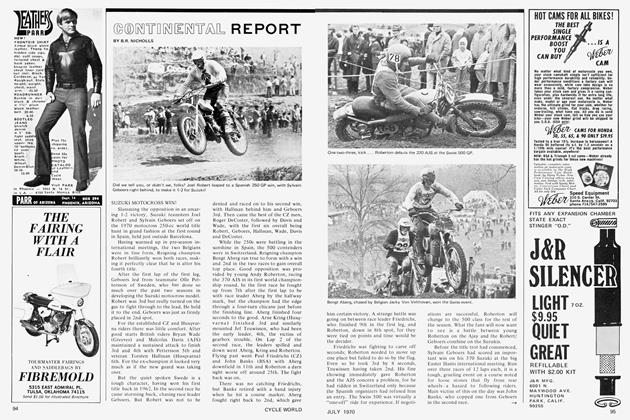
Ake Jonsson said goodbye to Maico Jnd signed for Yamaha in the motocross field. Yamaha finished the 1972 season with Jaak van Velthoven winning the Luxembourg round and taking fifth in the title fight with 57 points, only five points behind 2nd place Friedrichs. Jonsson, of course, finished 4th in the title where five different makes finished in the first five places. Jonsson is not only a brilliant motocross rider but is also a qualified engineer, so his experience should blend well with the younger Velthoven.
Maico will rely on last year’s rider Willi Bauer and he will be joined by Dutchman Gerrit Wolsink, who improves with every outing now that he has finished his dental studies and can spend all his time at motocross. The veteran Adolf Weil, whose name has ecome synonymous with Maico, is oving over to the 250 championship in 1973 in an experience and youth attempt by Maico to win the title from Joel Robert. The youth side will be Hans Maisch, but whether the factory will persevere with fuel injection in 1973 remains to be seen.
(Continued on page 138)
Continued from page 135
But the really big news for the four-stroke loving motocross fans is that John Banks will be back on a BSA powered machine for the 1973 world championship series. He has signed a contract to ride a Cheney BSA for Eric Cheney.
Banks will have four of them to contest the world and British 500cc titles, the idea being that two of the four would always be back at the workshops being fettled while Banks would have two complete machines at each championship round.
A silky smoothness to the basically BSA Victor engine has been obtained by adopting valve timing and sizes similar to those used with Gold Star engines together with a 1 -3/4-in. diameter exhaust pipe.
The 34mm Mikuni carburetor is the only non-British part, it being a 34mm Mikuni flexibly mounted to an inlet tract that has been bored out to 35mm.
Cheney forks, Rickman hubs, light alloy clutch and sprockets all go to achieve a weight of 210 lb., just 5 lb. over the FIM bottom limit, which was introduced this year. Each bike is handbuilt in the best Cheney tradition and with John Banks’ experience and ability to ride it could prove a real thorn in the flesh of the bigger factory sponsored efforts of 1973.
With so many works contracts now being signed by the trials and motocross riders the road racers almost seem to be left out in the cold. But that is still where the really big money is to be won and last year’s big money winner Paul Smart has departed the Hansen camp to ride for Suzuki. His replacement in the Kawasaki team will be Englishman Cliff Carr, who is no stranger to the threecylinder Japanese machines. All he needs is that little extra something called luck to see him on the winner’s rostrum in 1973. There is no doubt that U.S.-style 750 racing is catching the imagination of the factories and rumor has it that Honda is interested, but if so it seems to be a bit late in signing top riders.
SOUTH AFRICAN TT
The series being run in South Africa saw Giacomo Agostini, John Cooper, Mick Grant and Derek Chatterton dicing with the local aces. At the first meeting, the South African TT, the visitors could hardly have been said to cover themselves with glory.
Agostini failed to complete a race. Cooper, riding a 1972 John Player Norton, suffered the now almost customary gearbox problems and Mick ¡(^rant threw it away during the 350 race. He made amends in the main race of the day though by winning on his 350 Yamaha from Les van Breda (500 Suzuki) with Chatterton third on his 350 Yamaha. Chatterton won the 350 race and van Breda took the 750 class event.
ISLE OF MAN TT PROGRAM
The program for the 1973 Isle of Man TT races has been announced and with it comes the news that the 125cc race is to be dropped from the series so that the Senior race will be held in solitary splendor on the final Friday of the races. To tempt the stars, prize money for first places has been raised.
Dropping the 125s has enabled the A-C.U. to divide the prize money for ^iat event among the other races so that Pie Senior winner will now collect $2,350, but it is doubtful if the extra $600 will attract those like Agostini who have already said they will not race because the circuit is dangerous.
Improvements are being made on that score, too, with the mountain section coming in for improvement, the concrete posts on the resurfaced section that caused the death of Gilberto Parlotti last year being moved back and other posts also being removed. More resurfacing is being done there and in
the difficult Glen Helen section.
After all the impassioned outbursts after the last races many thought the races were doomed, indeed nobody can deny that much interest will be lost if MV does not attend, as it will belittle its world championship status, but the
Keer enthusiasm of the thousands of ns that visit the Island each year will probably keep it alive; and, provided that there are plenty of improvements from the safety angle, the races will remain the pinnacle to which all road racers will aspire.
SINGLE SOLO RACE
Not only has the A-C.U. altered the TT but it has also pulverized the British road race titles for 1973 by creating a single solo road race championship race instead of the five separate classes as in previous years.
In a revolutionary move, the single champion will be decided by a single race, but to qualify for that race a rider will have to score points at a number of qualifying rounds, riding a machine irom 251 to 750cc capacity, the eligibilPy of which will be decided by a simplified Formula 750 code. This will require 200 of the machines to have been made or 200 engine units if the machine is a special like the Triton and Norvins that are still quite popular. jg]