Report From Italy
REPORT FROM ITALY
CARLO PERELLI
EUROPEAN SEASON OPENS
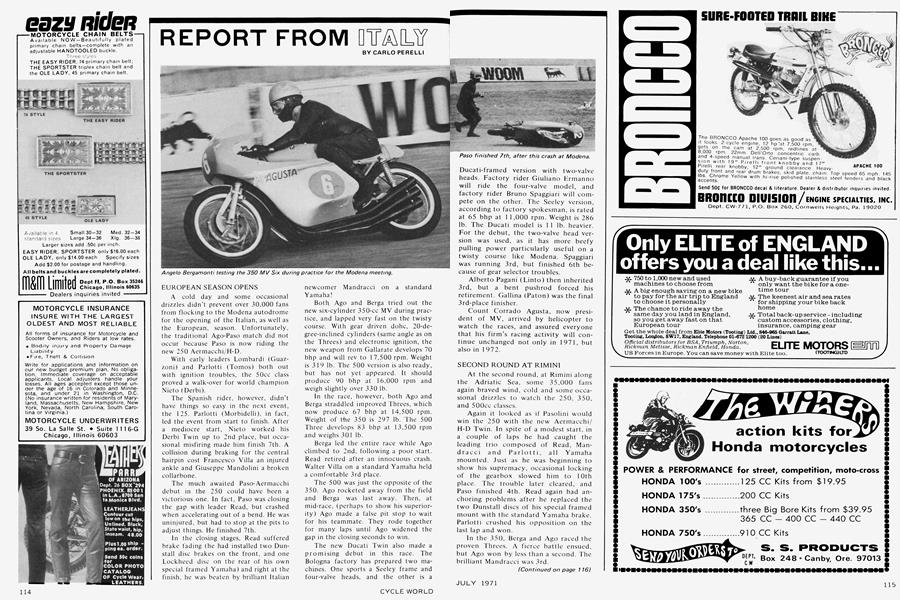
A cold day and some occasional drizzles didn't prevent over 30.000 fans from flocking to the Modena autodrome for the opening of the Italian, as well as the European, season. Unfortunately, the traditional Ago-Paso match did not occur because Paso is now riding the new 250 Aermacchi/H-D.
With early leaders Lombardi (Guazzoni) and Parlotti (Tomos) both out with ignition troubles, the 50cc class proved a walk-over for world champion Nieto ( Derbi).
The Spanish rider, however, didn’t have things so easy in the next event, the 1 25. Parlotti (Morbidelli), in fact, led the event from start to finish. After a mediocre start, Nieto worked his Derbi Twin up to 2nd place, but occasional misfiring made him finish 7th. A collision during braking for the central hairpin cost Francesco Villa an injured ankle and Giuseppe Mandolini a broken collarbone.
The much awaited Paso-Aermacchi debut in the 250 could have been a victorious one. In fact, Paso was closing the gap with leader Read, but crashed when accelerating out of a bend. He was uninjured, but had to stop at the pits to adjust things. He finished 7th.
In the closing stages, Read suffered brake fading (he had installed two Dunstall disc brakes on the front, and one Lockheed disc on the rear of his own special framed Yamaha) and right at the finish, he was beaten by brilliant Italian
newcomer Mandracci on a standard Ya ma ha !
Both Ago and Berga tried out the new six-cylinder 350-cc MV during practice, and lapped very fast on the twisty course. With gear driven dohe, 20-degree-inclined cylinders (same angle as on the Threes) and electronic ignition, the new weapon from Gallarate develops 70 bhp and will rev to 17,500 rpm. Weight is 319 lb. The 500 version is also ready, but has not yet appeared. It should produce 90 bhp at 16,000 rpm and weigh slightly over 330 lb.
In the race, however, both Ago and Berga straddled improved Threes, which now produce 67 bhp at 14,500 rpm. Weight of tiie 350 is 297 lb. The 500 Three develops 83 bhp at 13,500 rpm and weighs 301 lb.
Berga led the entire race while Ago climbed to 2nd, following a poor start. Read retired after an innocuous crash. Walter Villa on a standard Yamaha held a comfortable 3rd place.
The 500 was just the opposite of the 350. Ago rocketed away from the field and Berga was last away. Then, at mid-race, (perhaps to show his superiority) Ago made a false pit stop to wait for his teammate. They rode together for many laps until Ago widened the gap in the closing seconds to win.
The new Ducati Twin also made a promising debut in this race. The Bologna factory has prepared two machines. One sports a Seeley frame and four-valve heads, and the other is a Ducati-framed version with two-valve heads. Factory rider Giuliano Ermanno will ride the four-valve model, and factory rider Bruno Spaggiari will compete on the other. The Seeley version, according to factory spokesman, is rated at 65 blip at 1 1,000 rpm. Weight is 286 lb. The Ducati model is 1 1 lb. heavier. For the debut, the two-valve head version was used, as it has more beefy pulling power particularly useful on a twisty course like Modena. Spaggiari was running 3rd, but finished 6th because of gear selector troubles.
Alberto Pagani (Linto) then inherited 3rd, but a bent pushrod forced his retirement. Gallina (Paton) was the final 3rd-place finisher.
Count Corrado Agusta, now president of MV, arrived by helicopter to watch the races, and assured everyone that his firm’s racing activity will continue unchanged not only in 1971, but also in 1972.
SECOND ROUND AT RIMINI
At the second round, at Rimini along the Adriatic Sea, some 35,000 fans again braved wind, cold and some occasional drizzles to watch the 2 50, 3 50, and 500cc classes.
Again it looked as if Pasolini would win the 250 with the new Aermacchi/ H-D Twin. In spite of a modest start, in a couple of laps he had caught the leading trio composed of Read, Mandra cci and Par lot ti, all Yamaha mounted. Just as he was beginning to show his supremacy, occasional locking of the gearbox slowed him to 10th place. The trouble later cleared, and Paso finished 4th. Read again had anchoring problems after he replaced the two Dunstall discs of his special framed mount with the standard Yamaha brake. Parlotti crushed his opposition on the last lap and won.
In the 350, Berga and Ago raced the proven Threes. A fierce battle ensued, but Ago won by less than a second. The brilliant Mandracci was 3rd.
(Continued on page 116)
Continued from page 115
Fiberglass-framed, water-cooled, 50-cc Tomos.
This race also registered a most unusual accident: in the early stages, the fork yokes on Alan Barnett’s Yamsel broke in a bend and the English rider was lucky to escape the crash without injuries. Barnett also contested the 500, but again crashed without injury.
As at Modena, Berga was last away in the 500 and seemed to have no chance of winning after taking 2nd berth. But, a faulty condenser made Ago’s mount run on two cylinders, and Berga snatched the lead and won by nearly l min. Needless to say, Ago was very angry at the conclusion.
After a long tussle for 3rd place, Bertarelli (Kawasaki H l RA) got the best of Gallina (Paton). Pagani (Linto) had to work really hard to secure 6th place from a bunch of spirited riders composed of Perrone, Zubani, Baroncini, and Marsovsky.
with the fastest lap to his credit, Ago won by less than l sec. The brilliant Mandracci, after a slow start, came up to finish 3rd. He was the only rider not lapped by Ago and Berga.
FIBERGLASS-FRAMED 50
During practice for the Italian season opener at Modena, Gilberto Parlotti appeared on the track with a sensational fiberglass-framed 50-cc Tomos.
The Italian rider reported favorably on the new model, but minor ignition trouble prevented him from using it in the race, so he straddled last year’s more orthodox model.
Developed by Ing. Imperl Janez, rider/tester Bernetic, and an enthusiastic racing department, the new model is particularly slim, and weighs I2l lb. in racing condition.
The monocoque frame is made in two-halves united longitudinally, and contains the fuel tank. The pressed-steel rear swinging arm is very narrow around the spindle zone to enable the rider to keep his feet closer to the chassis for better streamlining. The front fork has no upper yoke, also in the interest of better streamlining.
A rotating-disc, water-cooled twostroke is used. The unit is fed by a huge 27-mm Dellorto carburetor, with a big float chamber of the same make on the left. With a bore and stroke of 40 by 39.6mm, and a compression ratio of 13:1, it revs to 15,500 rpm. When tuning is completed, 15.5 bhp should be available.
Ignition is by battery and coil, with the contact breaker assembly on the right, as is the gear primary drive to the six-speed gearbox. A wet-type multiplate is fitted. Wheels are shod with Dunlops, a 2.00-18 front, and a 2.25-18 rear.
DUCATI 500 RACER
The Ducati 500 Twin, taken to a satisfying debut at Modena by works rider Bruno Spaggiari, is another development of 51-year-old Ing. Fabio Tag lioni (of Desmodromic frame) and is intended as a mobile test bench for the 750and 900-cc roadsters available next summer.
Factory tester Giuliano Ermanno and Spaggiari report few vibrations, regardless of rpm from the 90-degree V-twin racing version. Moreover, the center of gravity is particularly low.
The engine uses two 250 model heads and cylinders on a crankcase that is also very similar to single-cylinder models. Therefore, bore and stroke dimensions are much oversquare at 74 by 58mm. Drive to the single ohcs is by bevel shafts and gears on the right. Another, but shorter, bevel shaft is employed on the same side to actuate the contact breakers for the coil ignition. Ignition, however, will probably be changed to the electronic type, manufactured by a special division of Ducati.
The wet sump lubrication system has been retained. The gear driven oil pump is on the right. Gear primary drive to a six-speed gearbox is on the left. A dry-type exposed clutch is used.
Both two-valve heads and four-valve heads will be used, depending on the circuit. The two-valve engine gives 62 bhp at 1 1,000 rpm, while the four-valve churns out 65 blip at 1 1,500 rpm. Large 40-mm carburetors are used on both units. The first engine is more flexible, the real surge coming on from 6000 rpm. The four-valve starts pulling at 8000 rpm.
The complete Ducati bike, with 1 8-in. wheels, now weighs 297 lb. Brakes have been changed to a front Ducati disc, fitted with Lockheed calipers. The rear brake is a Fontana unit. Suspension is by Marzocchi, and the front fork has provisions to take another disc, although Ing. Taglioni and factory riders say one is enough.
DUCATI 1 25 SCRAMBLER
On the lines of the recent 450 RT, Ducati has just introduced a 125 Scrambler. It is equipped with the well known single ohc unit, now with fivespeed gearbox and concentric carburetor. The little four-stroke produces 10 bhp at 8000 rpm at the rear wheel.
Wheels are shod with 2.50-19 front and 3.50-18 rear tires. Weight, in running condition, is 231 lb.